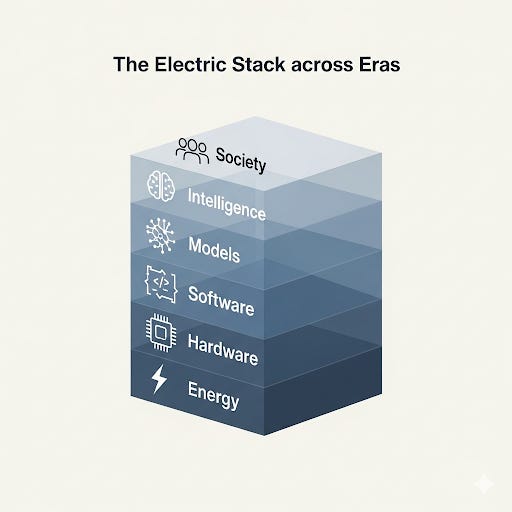
Civilizations don’t just rise; they scaffold themselves. Each era of human progress rests on an invisible “stack”, layers of energy, hardware, communication, and knowledge, stacked atop one another like a precarious but mighty tower.
The story of our world is not a flat story of kings and empires. It is a vertical story of layers laid down one atop the other. And in every century, those who controlled the base layers of the stack controlled the destiny of nations.
The British Era: Coal, Steel, and Telegraphs
Britain’s ascent was built on coal, the black rock that powered steam engines, factories, and warships. That energy flowed upward into hardware: railroads crisscrossing the land, ironworks churning out steel, telegraphs stretching communication across oceans. On top of this came a kind of software: the laws of contracts, trade codes, and bureaucracies that enabled the empire to manage its reach. Models emerged, too: economic theories, naval doctrines, and industrial processes that gave structure to expansion. Above them all stood the intelligence of the age: clerks, scholars, engineers, and explorers who catalogued the empire’s resources, charted its colonies, and systematized its knowledge. The result was a society transformed into a global trading and military superpower, its scaffolding visible in every shipyard, rail station, and colonial office.
The empire’s political and cultural dominance rested not on “British genius” alone but on its stack control: coal → rail → contracts → naval doctrines → explorers → colonization.
The American Century: Oil, Electricity, and Silicon
When Britain’s stack began to creak, America built its own. America’s rise was electrified by oil, natural gas, and nuclear power. That foundation coursed into hardware: automobiles and highways, airplanes and aircraft carriers, silicon chips and sprawling power grids. Layered on top was software, not only in the sense of code, but also in the contracts of corporate law and the abstractions of Wall Street finance. The models of the age were management science, consumer capitalism, and Cold War strategy, conceptual blueprints that shaped how resources were deployed. The intelligence layer belonged to research universities, DARPA, NASA, and corporate laboratories, institutions that turned abstract science into usable innovation. At the peak stood society itself, suburban life, mass consumption, pop culture, and America’s self-appointed role as global policeman, all underwritten by the electric scaffolding below.
This was also the century when Moore’s Law, the doubling of transistors on a chip roughly every two years, became civilization’s accelerant. Chips grew exponentially faster and cheaper, turning silicon into the oil of the information age. From calculators to supercomputers, from networks to the internet itself, Moore’s Law compounded like interest, powering America’s technological scaffolding.
But Moore’s Law had a counterweight. Page’s Law observed that software gets slower at the same rate that hardware gets faster. Each generation of machines grew mightier, yet bloated operating systems and enterprise code consumed the gains. Why did computers with 10x the power often feel just as sluggish? Because as silicon sprinted ahead, software trudged, dragging efficiency behind it. Moore’s Law gave acceleration; Page’s Law imposed friction. Together, they shaped the tempo of America’s digital empire.
Stacks Through History
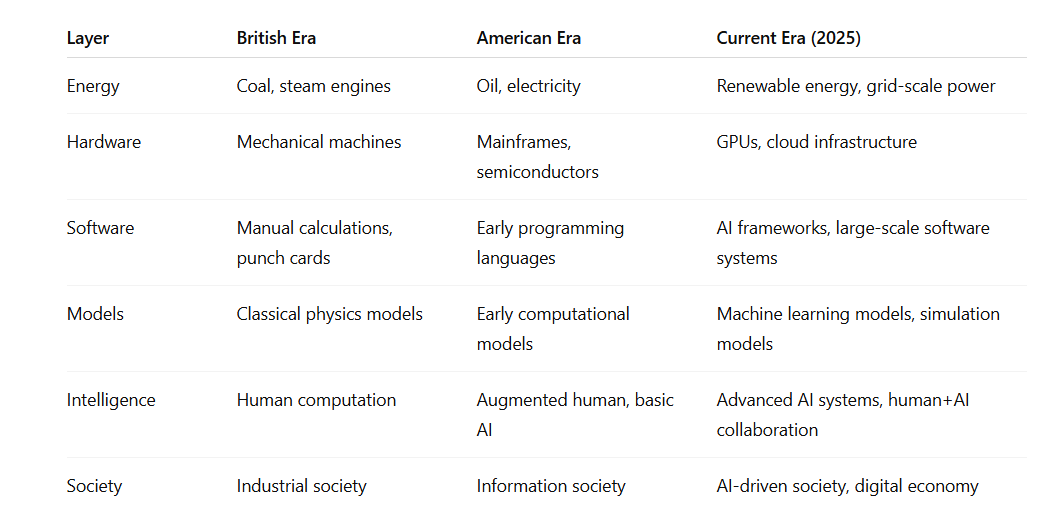
The Current AI/Electric Stack (2025)
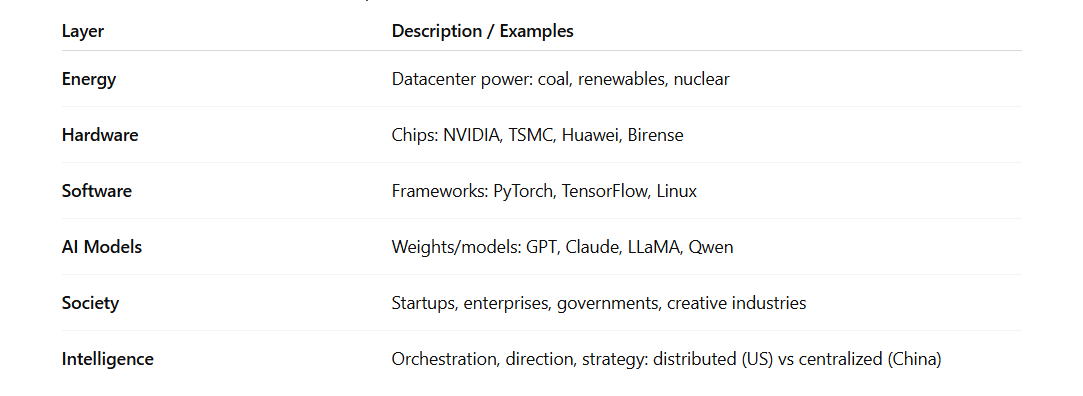
Today, we are in the middle of building a new tower. The foundation is once again energy: datacenter electricity, renewables, coal, nuclear. On top of that is hardware: GPUs, TPUs, and the cables that bind server farms together.
Here, the tension between Moore’s Law and Page’s Law is stark. GPUs now pack trillions of transistors, customized silicon is proliferating, and compute looks infinite compared to even a decade ago. Yet Page’s Law looms larger than ever: AI models balloon in size, frameworks sprawl, and training runs devour any new efficiency. Hardware races forward; models consume the spoils.
Above the hardware lie software frameworks: PyTorch, TensorFlow, JAX. These are the “assembly language” of the AI age.
Next comes AI models themselves: GPT, Claude, LLaMA, Qwen, and others.
Sitting above models is the new layer of intelligence: the researchers, institutions, and coordination mechanisms that interpret, steer, and deploy AI’s raw capability. Intelligence is not just about smarter models; it is about how societies align, regulate, and integrate them. Here, openness competes with centralization, and decentralized creativity contends with state-driven mobilization.
At the very top of the tower rests society: work, politics, art, and war. Just as coal once reshaped empires, GPUs and models, filtered through intelligence, are already reshaping the global order.
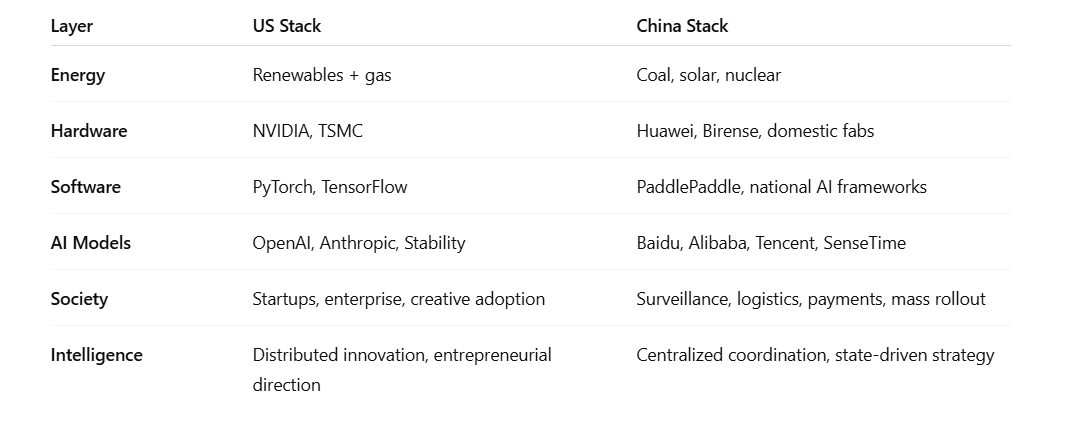
The Clash of Towers: US vs China
The 21st century may be decided not by armies or territory, but by whose AI stack dominates.
On one side stands the United States:
- Energy → datacenter power from renewables and gas
- Hardware → NVIDIA chips and the global semiconductor supply chain anchored in Taiwan (TSMC)
- Software → Open frameworks like PyTorch and TensorFlow, riding on Linux and open-source traditions
- AI Models → OpenAI, Anthropic, Stability AI, a swarm of startups
- Society → adoption through enterprises, startups, and creative industries; AI woven into productivity, art, and research
- Intelligence → hybrid human–machine problem-solving, amplified by openness and venture-backed scaling
On the other side stands China:
- Energy → coal-heavy today, but rapidly pivoting to solar, hydro, and nuclear megaprojects
- Hardware → Huawei, Birense, and domestic fabs are struggling against sanctions but gaining resilience
- Software → state-backed platforms, less open but tightly integrated
- AI Models → Baidu, Alibaba, Tencent, SenseTime: competing aggressively in vision, language, and multimodal systems
- Society → ubiquitous deployment in payments, logistics, surveillance; AI as state infrastructure, not a startup playground
- Intelligence → centralized orchestration, where machine intelligence is directed to reinforce national goals.
US vs China Stack
At the center lies the flashpoint: AI weights. Open or closed, free or restricted, shared or hoarded. This is the choke point where the two towers strain against each other.
Open vs Closed Weights: The New Faultline
Every stack in history has had its great fault lines. In the British Stack, it was access to coal and colonies. In the American Stack, it was access to oil and microchips. In today’s Electric Stack, the great divide is between open weights and closed weights.
- Closed weights are like walled empires: OpenAI’s GPT-4, Anthropic’s Claude, Google’s Gemini. They keep the crown jewels private, renting them out but never handing over the keys
- Open weights are the free ports and printing presses of this new world: Meta’s LLaMA, Mistral, Falcon, China’s Qwen. Anyone can download, fine-tune, and build upon them
And lurking behind this divide is Page’s Law again. Closed systems risk locking inefficiency into silos, while open systems spread optimization across thousands of hands. The battle over weights is also a battle over whether Moore’s gains are consumed by bloat or reclaimed through open experimentation.
This struggle, between open and closed, is not just about technology. It is about who controls the future of knowledge itself. Just as the British guarded trade routes, and the Americans guarded semiconductors, today’s powers guard their AI weights.
What makes this dramatic is the split at the intelligence layer:
- America’s scaffolding aims for open-ended innovation, messy but generative
- China’s scaffolding aims for directed intelligence, centralized but massive in scale
That’s the clash point: not just a competition of chips or models, but a race to decide what form intelligence-as-a-layer will take globally.
Who Dominates the Current Stack?
The truth is, no one dominates the entire thing. But each layer has its ruler:
- Energy: China, with its colossal coal and renewable reserves
- Hardware (Chips): United States, with NVIDIA’s global chokehold
- Software (Frameworks): United States, via PyTorch and TensorFlow
- AI Models (Weights): United States, leading frontier capabilities
- Society (Adoption): Split — US in startups and enterprise, China in state rollout
- Intelligence (Direction & Orchestration) → This one is contested
- The US excels in distributed intelligence — many labs, startups, and individuals experimenting freely
- China excels in centralized intelligence — national coordination, strategic focus, and scaled deployment
Put together, this means the United States still leads the upper stack (chips, software, models, and distributed innovation), while China holds critical leverage at the lower stack (energy, scale, national mobilization).
History suggests a pattern: control the base layers long enough, and you eventually bend the higher layers to your advantage. But the duel between Moore’s Law and Page’s Law complicates the script. Moore’s Law pushes capabilities upward at exponential speed, but Page’s Law ensures inefficiencies scale too. The race is not only about who controls chips or energy, but whose institutions and open ecosystems can overcome software drag to turn raw compute into civilization-shaping intelligence. The question isn’t just who controls the pipes, but whose vision of intelligence directs the flow.
The future is a scaffolding still under construction. And the hands that tighten its bolts will decide more than markets; they will decide civilization’s next chapter.
Addendum: Beyond the Electric Stack
The Electric Stack shows us progress through the lens of power: who builds, who leads, who dominates. But readers have asked deeper questions that expand the frame.
- Nations That Don’t Lead the Stack: What about nations that don’t lead the stack but still thrive?
History shows us that progress isn’t only vertical. Switzerland in finance, Japan in hardware, the Nordics in welfare, and Singapore in governance all found ways to thrive without being at the top of the Electric Stack. Sometimes, strength lies in finding a smart footing around the tower rather than leading it. - The Blind Spots: What are we missing today, and how can we recognize it in time?
The honest answer: We rarely know in the moment. The gaps reveal themselves only in hindsight. The best we can do is to keep asking uncomfortable questions, widen the lens beyond technology, and invite more disciplines into the conversation. The “missing” isn’t a failure of foresight; it’s an ongoing practice of humility. - Beyond Power: If we don’t consider power alone, does the Electric Stack fully account for progress? Or do we need other stacks too? Alternate stacks: cultural, governance, human development, ecological, and financial show us that nations can secure relevance without leading the tower of power.
And that leaves us with a trinity worth holding onto:
- Power (who builds and leads)
- Position (how others thrive without leading)
- Perspective (the humility to see what we might miss)
Nations That Don’t Lead the Stack: What about nations that don’t lead the stack but still thrive?
A stack layer usually describes a functional dependency (e.g., energy → hardware → software → models → intelligence → society). “Positioning” or “relation to the stack” is not a dependency, but a strategic stance.
This is where we need to think beyond layers. Not every nation climbs the vertical tower of energy → hardware → software → models → intelligence → society. Some instead thrive by how they relate to the stack.
We could call it a Relational Dimension that always exists around the stack, shaping how nations fit across eras. This could be visualized as orbitals around the stack.
- Builders (US, Britain, China, in their eras): they construct the vertical tower.
- Positioners (Switzerland in finance, Singapore in governance): they place themselves strategically around the tower
- Integrators (Canada aligning to US industries, Japan in hardware, Korea in semiconductors): they plug into parts of the tower
- Diversifiers (Venice in trade, Nordics in welfare): they develop niches beyond the tower
- Resisters (Tokugawa Japan, Cold War Non-Aligned Russia now): they keep a distance
This pattern holds across eras: every age has its builders, positioners, integrators, diversifiers, and resisters. The Electric Stack shows how progress is layered, but the Relational Dimension shows where nations stand in relation to it.
- In the British era, Switzerland positioned itself around trust and finance
- In the American era, Japan positioned itself through hardware innovation, while the Nordics built resilient welfare societies
- In the current AI era, countries like Singapore, Australia, or the Nordics continue to thrive by playing to their unique strengths, even without leading compute or models
Beyond Power: If dominance isn’t everything, what else defines progress?
And perhaps this suggests something more significant: if we don’t consider power alone, does the Electric Stack fully account for progress? Or do we need other stacks too?
This is where stacks meet metaphors. Not every domain of progress neatly fits into the logic of layers, scaffolds, and towers. Some do, others resist, and the difference matters.
Stacks: Layered, Cumulative, Architectures of Progress
Some aspects of civilization truly are “stack-like.” They build layer upon layer, with each foundation enabling the next:
- Governance Stack: Institutions, rules, and trust architectures layered across time, from village councils to constitutional frameworks to supranational orders.
- Financial Stack: Networks of trade, credit, banking, and capital markets that accumulate and interlock, enabling global flows of wealth.
These are “stacks” in the same sense as the Electric Stack: they have dependencies and order, and leadership can be measured in who builds or shapes the higher layers.
Metaphors: Other Shapes of Progress
But other domains of progress are harder to capture in stack logic. They are real drivers of thriving, but they work differently:
- Cultural Webs: Stories, myths, values, and norms that spread laterally and entangle societies. France, India, or Hollywood thrive not by stacking, but by weaving cultural influence across borders.
- Human Development Cycles: Education, health, dignity, and welfare repeat across generations. Each cycle renews human capital, creating virtuous (or vicious) loops.
- Ecological Balances: The environment resists stacking; it works more like a system of thresholds. Overshoot and collapse are the risks, balance and adaptation are the goals.
Here, the metaphors aren’t towers but webs, flows, cycles, and thresholds. They describe progress not as dominance or hierarchy, but as resilience, renewal, and reach.
Why This Matters
By combining stacks with other metaphors, we expand our toolkit:
- Stacks help us see the architecture of power: who builds, who leads, who controls.
- Webs, cycles, flows, and balances help us see the conditions of thriving: how nations endure even without leading.
Progress, then, isn’t just a tower to climb. It’s a landscape of structures and metaphors, each lens revealing different truths. The challenge is not to pick one, but to know which lens to apply, when.
These alternate lenses don’t replace the Electric Stack, but complement it. They remind us that the architecture of progress is plural; not every nation climbs the same tower, but each must find a footing that secures its place in the world.
Stacks vs. Other Metaphors of Progress
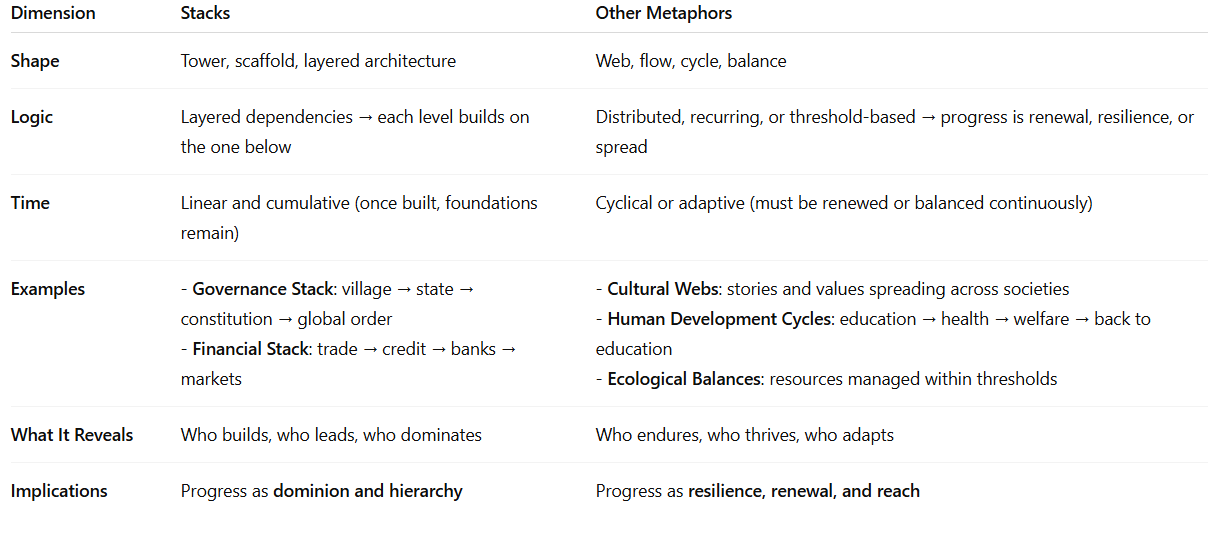
Together, they form a dual lens:
- Stacks show us the architecture of power
- Other metaphors show us the conditions of thriving
Neither is sufficient alone. But combined, they prevent us from mistaking dominance for the only measure of progress.
The Electric Stack gives us a powerful lens, but it is not the only one. Nations progress not just by leading in power, but also by learning how to last. To expand the frame, here’s a simple grid that maps two questions: Who leads? Who lasts? against two modes of thinking: Stacks (systems) and Metaphors (lenses).,

Walking the Grid
- Top-left (Stacks + Power): This is the familiar story, nations race to climb the tallest stack, from steam to silicon to AI. Whoever gets higher faster dominates.
- Top-right (Stacks + Thriving): But history shows another path: build the right stack for your context. Switzerland didn’t lead in energy or hardware, yet its financial stack made it indispensable.
- Bottom-left (Metaphors + Power): Shift the view, and power looks less like towers and more like flows, currents of capital, alliances, or influence that surge and ebb. Leaders don’t just climb; they channel.
- Bottom-right (Metaphors + Thriving): And finally, the deepest lens: nations as living systems. Progress isn’t height, it’s health, balance across culture, ecology, governance, and human dignity.
The grid reminds us: nations don’t just compete to climb; they choose how to stand, flow, or thrive. Progress is plural, and the future will reward those who know which game they are playing.