Humanity has always relied on trustworthy knowledge to build science, culture, technology, and governance. From oral traditions to manuscripts, printed books, journals, and the digital era, the ability to capture, transmit, and verify truth has driven progress. Yet today, we stand at a critical juncture.
AI systems can generate immense volumes of content almost instantaneously. While this seems like a boon, it comes with a subtle but profound risk: if the provenance of knowledge breaks down, the very foundations of human understanding could erode. Unlike earlier eras, where knowledge loss was slow and often localized, AI has the potential to flood global information systems with unchecked, unverified outputs, creating a digital echo chamber.
This is not simply about what we know, but how we know it. If provenance collapses, knowledge itself may fragment. If provenance strengthens, a new age of discovery might emerge.
We will look at:
- How knowledge historically grew and survived disruptions
- How provenance systems function to preserve truth
- How AI is changing the incentives for humans to contribute, verify, and innovate
- What plausible futures lie ahead if these trends continue
- What decides these outcomes and the likely path forward
How Knowledge Grew — Then and Now
Knowledge has always evolved through active curiosity, dialogue, and observation. Communities, scribes, and later editors acted as filters, ensuring that what was recorded was both meaningful and verifiable.
But today, AI shifts the dynamic. Instead of observation and dialogue, we have generation and prediction.
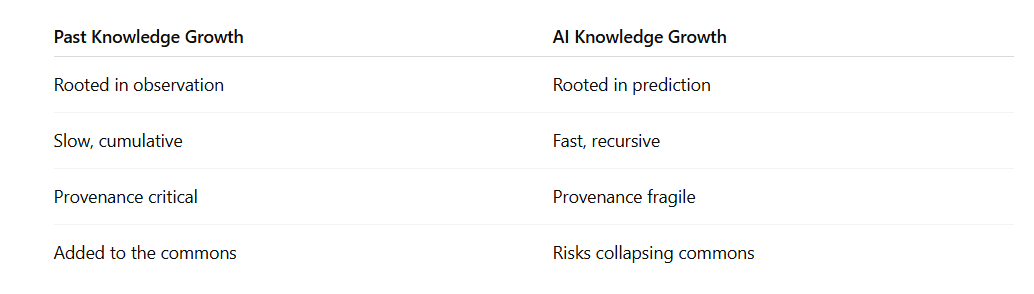
How Knowledge Used to Grow
The historical arc: Oral Traditions → Writing → Print → Scientific Revolution → Digital Era
- Oral traditions relied on memory and community transmission
- Scribes and manuscripts created fragile but enduring records
- The printing press amplified knowledge but also errors, necessitating filters like peer review
- Science formalized institutions to preserve truth
The trio of Observation + Transmission + Provenance powered this growth. Each was fragile, but together they held civilization up.
Now AI stresses them in new ways.
Where Provenance Is Failing Now
Today, provenance is eroding in multiple domains:
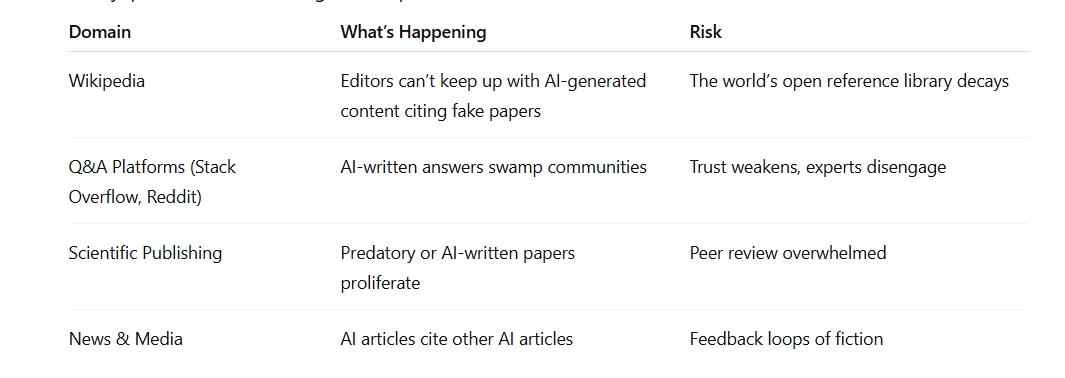
This isn’t just about accuracy, it’s about memory. If future AIs are trained mostly on AI outputs, recursive decay looms. Knowledge risks turning into an echo chamber of echoes.
Historical Rhymes
We’ve been here before. History shows that knowledge often falters, but can rebound:
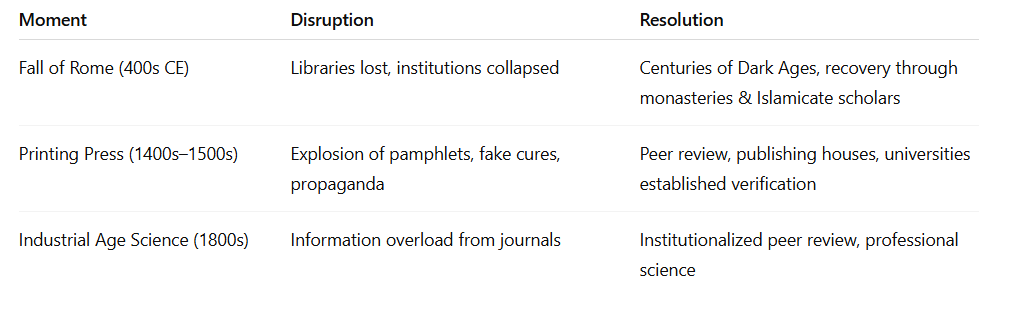
Parallel to now: LLMs are our new press: chaos at first, then perhaps new systems of verification.
Four Futures Ahead
The way provenance is rebuilt (or not) will determine our path.
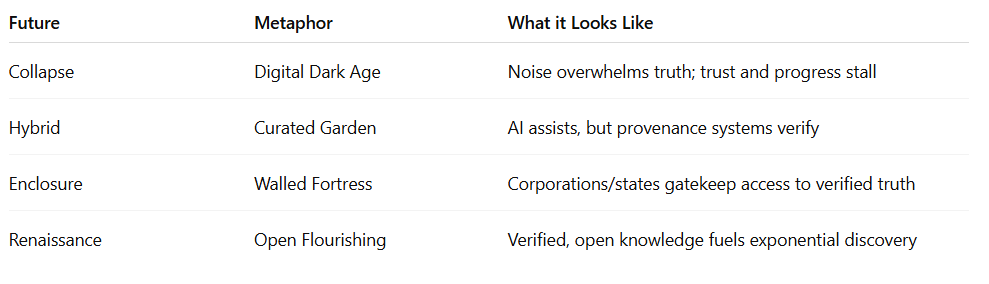
Collapse (Digital Dark Age)
- AI floods platforms with noise; humans disengage
- Open knowledge repositories lose trust
- Education degrades into learning from AI summaries
- Progress stalls as errors multiply
Hybrid Survival (New Verification Infrastructure)
- Open-source AI tools are paired with provenance systems (watermarks, blockchain, community curation)
- Contributors are incentivized to provide verified content
- Trust is preserved; innovation continues broadly
Enclosure (Knowledge Silos)
- Corporations or states monopolize access to verified data
- Knowledge grows, but inequality deepens
- Public becomes passive consumers; critical thinking erodes
Renaissance 2.0 (Optimistic Breakthrough)
- AI and humans co-create, with strong provenance checks
- Verification is global, open, and scalable
- Knowledge flourishes, fueling science, art, and culture
Drivers of Which Future Wins
The four key drivers shape our path:

Ranking the Drivers
- Economics: if no one pays for provenance, collapse is near certain
- Culture: if society doesn’t value truth, no system survives
- Regulation: can push us toward Hybrid or Enclosure
- Technology: necessary but insufficient; tools only matter if economics + culture align
Likely Path (as of now, 2025)
- Short-term (next 5 years): A Hybrid + Enclosure mix emerges. Corporations build silos; provenance experiments (watermarks, signatures) remain underfunded.
- Medium-term (10–15 years): Which dominates depends on whether open provenance systems get real funding (Hybrid wins) or corporations capture trust (Enclosure wins).
- Long-term: Collapse is possible if incentives fail completely. Renaissance is possible if all four drivers align; a hard, but not impossible outcome.
The Choice Before Us
Knowledge is not self-sustaining. It survives only when societies deliberately protect provenance, reward curiosity, and build systems that value truth over convenience.
History shows both collapse and renewal. Rome’s libraries burned, but the greater loss was cultural: people stopped copying, debating, and transmitting. The printing press unleashed chaos before peer review rebuilt trust. Each turning point required human choice.
Today, AI offers both peril and promise. If left unchecked, it could drown truth in noise. But if paired with strong cultural, economic, and regulatory commitments to provenance, it could spark a new renaissance of discovery.
The fragile future of knowledge rests not in machines, but in us. Collapse, enclosure, hybrid survival, or renaissance; the choice is ours. And history tells us: the future belongs to those who preserve truth.