
PS. I wrote about AI & cognition some time back, and this one is an expansion on the same premise
Summary of the post: “From Hype to Utility: What AI Needs to Become Truly Transformative”
The earlier post explores why current artificial intelligence, despite its advancements, remains limited in practical value. I emphasized that existing models lack critical abilities such as:
- Generalization across varied tasks and environments
- Persistent, context-rich memory
- True autonomy in goal-setting and planning
- The capability for continual, adaptive learning
Ultimately, transformative AI demands breakthroughs beyond incremental scaling or model engineering, requiring fundamentally new approaches centered on adaptability and robustness.
How Human Brains Have Evolved
Imagine your brain as a team of superheroes, each with a special power, working together to help you think, learn, remember, and feel.
- The senses (like your eyes and ears) send signals to your brain—this is like receiving mission alerts.
- The sensory cortex reads these alerts and helps you see, hear, and feel things clearly.
- The hippocampus is your memory superhero—it stores stories from your day so you can remember them later.
- The prefrontal cortex helps you make decisions and solve problems—like the team leader planning what to do next.
- The limbic system decides what’s important and how you should feel about it—like a mood detector.
- The neocortex is the smart thinker—good at understanding language, patterns, and new ideas.
Over millions of years, evolution trained this superhero team to be great at:
- Learning from very little information
- Remembering things for a long time
- Connecting old memories to new situations
- Solving tricky problems in new ways
- Making their own plans and chasing goals
Everything works together all the time. That’s why humans can adapt, create, and think in ways no machine today can fully match.
Current Techniques Used for AGI
1. Large Language Models (LLMs)
- What they do: Generate human-like text based on training data. Great at completing sentences, summarizing documents, and answering questions.
- Where they fall short: They don’t truly understand meaning. They rely on patterns, not reasoning, and forget context quickly. No persistent memory or agency.
2. Agentic AI
- What it does: Chains LLMs into goal-directed “agents” that take actions (like browsing, coding, or running tools).
- Where it fails: Still built on LLMs, so agents hallucinate, forget, or chase unclear goals. Autonomy is brittle and often requires constant human scaffolding.
3. Multimodal AI
- What it does: Processes different types of inputs—text, images, video, audio—together.
- Where it fails: While it expands inputs, it doesn’t fix underlying problems with reasoning, memory, or abstraction.
4. Hybrid Architectures (Symbolic + Neural)
- What they do: Combine rule-based reasoning with neural networks to blend logic and pattern recognition.
- Where they fail: Integration is hard. Symbolic systems are brittle, neural networks are opaque, and they don’t always “talk” well to each other.
To be clear, today’s AI systems have accomplished remarkable things—LLMs write fluent text, multimodal models can describe images and videos, and agents can automate tasks. These successes show that pattern-matching at scale enables narrow forms of generalization.
However, what they lack is the kind of flexible, grounded, and goal-driven intelligence that defines human cognition—and that’s what AGI ultimately requires.
Imagine trying to teach a robot to navigate your messy home after it’s been trained only in office floor plans. Today’s AI would trip on your dog’s toy and forget your hallway even exists. It doesn’t learn or adapt on the fly.
Where These Techniques Fail
- Absence of Persistent, Multi-Scale Memory: Context and memory do not carry smoothly across conversations, sessions, or domains.
- Deficient Continual and Transfer Learning: Systems rarely adapt in real time or transfer knowledge across unrelated tasks without retraining.
- Weak Abstraction and Conceptual Reasoning: Existing models interpolate well but fail at true abstraction, analogy, and generalization.
- Lack of Autonomous Agency: Predominantly reactive, they do not set or pursue their own goals or plans.
- Brittleness and Siloed Functions: Models often break down in novel scenarios and keep perception, memory, and reasoning siloed rather than integrated.
- Diminishing Returns from Scaling: Simply adding more compute and data has reached a point of diminishing returns. Larger neural networks become costlier but not meaningfully more intelligent. They memorize more but still lack true understanding, planning, or abstraction.
One challenge with cognitive AI is measurement. Traditional benchmarks like image classification or code generation are insufficient. We’ll need new tests—long-term memory retention, open-ended problem-solving, adaptation to novel environments—to assess whether a system truly “thinks” like a mind.
New Thinking: Toward Cognitive AI Frameworks
Think of this blueprint like a city: different “districts” specialize (memory, planning, emotion), but it’s the “roads” (the integration layer) that make the city come alive.
Drawing lessons from human evolution, a new paradigm is emerging—Cognitive AI. This approach seeks to endow AI systems with:
- Hierarchical, Modular Architectures: Mirroring the brain’s structure by dividing computation among specialized, interconnected modules (for perception, memory, reasoning, and emotive processing).
- Integrated Short- and Long-Term Memory: Seamless blending and persistence of context across tasks and time, much as the brain synchronizes working and episodic memory.
- True Continual and Meta-Learning: Enabling models to learn from ongoing interactions, transfer skills, and adapt rapidly with little data.
- Synergistic Processing: Coordinating analytic (logical) and intuitive (creative, analogical) sub-systems, reflecting the cooperation of human brain regions.
- Goal-Driven, Adaptive Agents: Architectures that support self-initiated objectives, multi-step planning, and autonomous problem-solving.
- Multimodal, Contextual Integration: Ability to process and synthesize information from varied sources and modalities—text, vision, audio—in a unified framework.
Example Blueprint: Cognitive Simulation Architecture
Note: While this blueprint draws on high-level parallels with brain regions, real biological cognition is far more interconnected and fluid. Functions like memory and reasoning do not reside in neatly defined “modules,” but emerge from dynamic interactions across the brain. This architecture is meant as a conceptual aid, not a literal mapping.
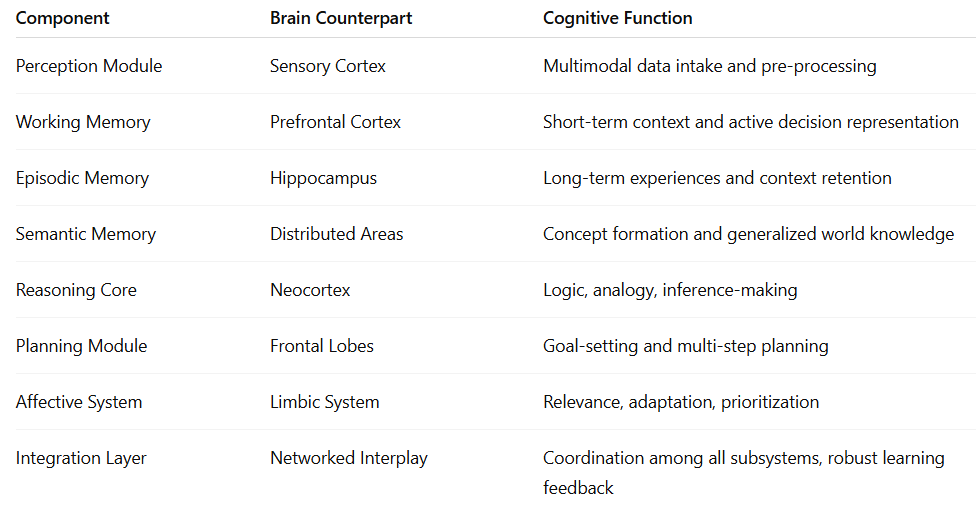
By explicitly simulating the evolutionary strengths of the brain—hierarchical abstraction, persistent memory, modularity, continual learning, synergy, and agency—such frameworks aim to overcome the core obstacles of current AI approaches and pave the way toward genuine AGI.
Despite this promising direction, many of these capabilities—such as real-time continual learning, integrated memory, or multi-modal reasoning—are still in early research stages. Today’s systems are far from achieving the full vision outlined here. Cognitive AI remains a long-term aspiration requiring foundational advances in both architecture and theory.
A Cautionary Note on Cognitive AI
Intelligence Is Not the Same as Alignment
As we build increasingly capable cognitive systems, we must remember: intelligence does not imply empathy, safety, or alignment. A machine that can plan and reason like a human can also pursue unintended goals with high competence.
Just as humans need ethical education and societal norms, cognitive AI must be aligned from the ground up. Research into alignment, interpretability, and oversight must evolve alongside intelligence itself.
While Cognitive AI presents a promising path forward, it’s important to recognize its limitations, risks, and realistic timelines.
What Cognitive AI can potentially offer:
- More adaptive, robust AI that learns from fewer examples and generalizes better across domains.
- Systems with longer memory, richer world models, and more coherent goal-driven behavior.
- Better alignment with how humans interact with knowledge, tools, and environments—leading to safer, more reliable agents.
What Cognitive AI will not immediately do:
- Solve AGI overnight. Building systems with brain-like flexibility and integration is immensely complex and requires more than clever engineering—it may need foundational scientific breakthroughs.
- Replace human intuition or morality. Cognitive architectures can model reasoning, but won’t automatically inherit ethics, values, or common sense wisdom.
- Remove all black-box issues. Even with modular design, deep systems remain hard to audit without strong interpretability layers.
- Guarantee alignment. A more autonomous system doesn’t mean it’s aligned—sometimes the opposite.
Realistic timelines:
Cognitive AI is a long-term vision—not a product next quarter. Expect:
- Short-term gains in narrow, adaptive use cases (e.g., copilots, planning agents, assistants with richer memory)
- Medium-term emergence of lifelong-learning systems that improve with experience
- Long-term goals toward general-purpose agents that reason, adapt, and grow much like humans do
A Vision, Not a Guarantee
Cognitive AI holds immense promise—but it’s not a magic bullet. It won’t instantly make machines conscious, or wise, or ethical. Progress may be slow and messy, requiring decades of work. But by shifting the frame from brute force to brain-inspired adaptability, we may finally unlock AI that truly understands—and evolves with—our world.