“The multiverse is not speculation. It’s what our best science is already telling us” ~ David Deutsch
Why Start with Quantum Theory?
You can’t understand Deutsch’s worldview without starting here.
Quantum theory isn’t just a piece of physics. It’s the foundation stone for how he sees reality, knowledge, and progress.
And here’s the shocker:
The same physics that gave us lasers, smartphones, and MRI machines also says…
You live in just one branch of a vast, branching reality.
That’s not science fiction. It’s the logical consequence of equations that have been tested to mind-bending precision, and I will leave this for a separate post on another day.
Everyday Life vs. Quantum Life
In our normal, human-sized world:
- A coin is either heads or tails
- You either catch the bus or you miss it
- Your tea is either hot or cold
In the quantum world, the realm of particles smaller than atoms, things behave differently.
- A particle can be here and there at the same time
- It can spin clockwise and counterclockwise simultaneously
- It can go through two doors at once
Physicists call this superposition.
Analogy: Imagine you’re both sitting in your living room and walking in the park at the same time, and both are equally real
The Cat Thought Experiment
Erwin Schrödinger, in 1935, invented a famous thought experiment:
- A cat is inside a sealed box with a tiny amount of radioactive material
- If an atom decays, poison is released, killing the cat
- If not, the cat lives
- After one hour, the chance of decay is 50%
According to quantum mechanics:
- Until you open the box, the cat is both alive and dead in a superposition
How Do We Explain This? Two Competing Views
1. Copenhagen Interpretation, Niels Bohr, 1920s
- Reality “chooses” one outcome when we observe it
- Before observation, the possibilities are fuzzy, not real
Analogy: The story hasn’t been written until you open the book
2. Many-Worlds Interpretation, Hugh Everett, 1950s (championed by Deutsch)
- All outcomes happen, but in different, parallel universes
- When the cat experiment is done, reality splits:
- In one world, the cat is alive
- In another, the cat is dead
Analogy: The author writes every possible ending to the story, but you can only read one copy
Where Deutsch Enters the Story
By the 1980s, quantum theory was already the most successful theory in physics. However, most scientists avoided discussing what it meant.
David Deutsch argued:
- The Many-Worlds interpretation isn’t just one option, it’s the only one that makes sense of quantum computing
- The “weirdness” is reality itself, not just a math trick
Quantum Computers — Why the Multiverse is Practical
Normal computers use bits (0 or 1).
Quantum computers use qubits (0, 1, or both at once).
- A classical computer solves problems step by step.
- A quantum computer can explore many solutions at the same time, each in a different branch of the multiverse, and then combine the answers
Analogy:
- Normal: You look for your lost keys one room at a time
- Quantum: You send a friend into every room at once and get the answer instantly
Deutsch was the first to show mathematically that this parallelism is real, not just a metaphor.
Critiques of the Many-Worlds View
Not everyone buys the idea that reality constantly branches into parallel universes.
Main criticisms:
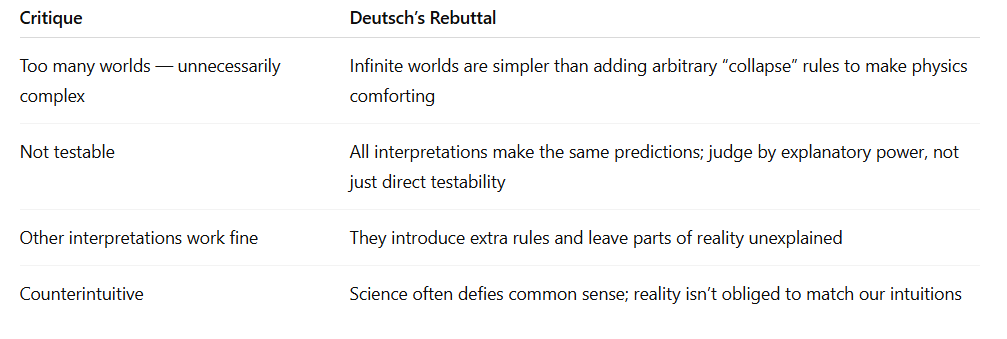
- Too many worlds: Some say it needlessly creates infinite universes we can’t see
- Not testable (yet): Since we can’t interact with other branches, it may be beyond the reach of science
- Other interpretations work fine: Copenhagen, pilot-wave theory, and others explain quantum results without parallel worlds
- Counterintuitive: It’s hard to imagine every possibility being equally real
Deutsch’s Response
- Simplicity wins: Many-Worlds explains quantum physics without extra, ad hoc rules
- Evidence in action: Quantum computers work because they seem to compute across multiple branches
- Reality is reality: Comfort isn’t a scientific criterion. If reality is strange, we must face it
Critique vs. Deutsch’s Rebuttal
Additional Quantum Concepts You’ll Hear
We’ve focused on Many-Worlds and quantum computing so far. But Deutsch’s bigger framework leans on other quantum ideas that are worth keeping in your toolkit. These aren’t just physics trivia; they shape how we understand computation, evolution, and even decision-making in complex systems.
Wave–Particle Duality
Light and matter can act like both waves and particles depending on how you observe them.
Useful for: Understanding why classical categories (“it’s a wave” or “it’s a particle”) sometimes fail, and why flexible thinking matters in science and problem-solving.
Superposition Principle
A quantum object can exist in multiple states at once until it’s measured.
Useful for: Thinking creatively about possibilities before narrowing down options, in science, business, or strategy.
Uncertainty Principle
You can’t know certain properties (like position and momentum) with perfect accuracy at the same time.
Useful for: Accepting that limits to precision are sometimes baked into reality, which affects measurement, forecasting, and risk planning.
Probability & Wavefunction
The wavefunction encodes probabilities of all outcomes; measurement reveals one.
Useful for: Framing decisions in terms of probabilities instead of certainties, useful in AI, climate modeling, and finance.
Non-Commutativity of Observables
The order in which you measure things can change the outcome.
Useful for: Understanding processes where sequence matters, from quantum experiments to organizational workflows.
Measurement & Collapse (Copenhagen view)
Observation “collapses” possibilities into a single reality.
Useful for: Thinking about how choices or attention can fix one path and close others, in science and in life.
Energy Quantization
Energy levels in quantum systems come in discrete jumps, not continuous flows.
Useful for: Explaining atomic stability, lasers, and why some changes happen in leaps, not gradual shifts.
Complementarity Principle
Different experiments can reveal different, mutually exclusive properties of the same system.
Useful for: Understanding trade-offs, you can’t always get all the information at once.
Entanglement
Particles can be connected so that changes to one instantly affect the other, even over large distances.
Useful for: Quantum encryption, teleportation research, and seeing how connections in systems can produce non-local effects.
Quantum Operators & State Vectors
Mathematical tools for describing and changing quantum states.
Useful for: The formal language behind quantum computing algorithms and advanced physics modeling.
Interpretations of Quantum Mechanics
Different philosophical takes on what quantum theory means: Many-Worlds, Copenhagen, pilot-wave, etc.
Useful for: Understanding that science often has multiple explanatory models, and progress means testing which ones hold up.
Why This Matters to Deutsch’s Theory of Everything
This is one of his Four Strands of Reality.
It connects to the others like this:
- Epistemology: How do we know Many-Worlds is true? By seeking explanations that are harder to vary
- Computation: Quantum computers depend on parallel universes
- Evolution: Multiple possible realities open multiple evolutionary pathways
Without quantum theory, Deutsch’s bigger picture of infinite progress would lose its physical foundation.
What This Means for You
Quantum theory, and Deutsch’s interpretation of it, isn’t just abstract physics. It’s a way of seeing the world that can influence how you think, solve problems, and prepare for the future.
Here’s how:
- Reality is bigger, richer, and stranger than your senses suggest
- The world is not limited to what you directly observe
- Adopting this mindset helps you stay open to hidden variables, unseen opportunities, and unexpected connections
- Everyday example: Just because you can’t see all the data about a market trend doesn’t mean it’s not there, a multiverse mindset keeps you curious
- Thinking in “many possibilities” improves problem-solving
- In the Many-Worlds view, reality doesn’t “pick” one path until it happens; multiple paths exist in parallel
- Training yourself to think in parallel scenarios (Plan A, Plan B, Plan C) prepares you for uncertainty
- Everyday example: A business leader weighing multiple market-entry strategies can explore each in detail rather than betting everything on one “best guess”
- Break free from binary thinking
- Our daily decisions are often framed as “yes or no,” “win or lose,” “this or that”
- Quantum thinking encourages “both/and” possibilities where outcomes can coexist and influence each other
- Everyday example: Negotiations don’t have to be either you win or I win, they can be structured so both sides gain
- Embrace uncertainty as an advantage
- In quantum mechanics, uncertainty is not ignorance, it’s a fundamental property of reality
- Accepting uncertainty allows you to act confidently without demanding perfect information
- Everyday example: Investors who accept market volatility as a given can focus on building robust, long-term strategies rather than chasing “perfect timing”
- Recognize that technology will reshape possibilities
- Quantum principles already underpin technologies like semiconductors, lasers, and MRI machines, and soon, quantum computers
- Understanding the basics of quantum thinking prepares you for breakthroughs in AI, drug design, climate modeling, and cryptography
- Everyday example: A manager who understands quantum computing’s potential may spot early opportunities to apply it in supply chain optimization before competitors
- Think like a scientist, in every field
- Deutsch’s worldview treats problems as soluble; given the right explanations, we can always improve our understanding and solutions
- You don’t have to be a physicist to adopt this mindset: test ideas, welcome criticism, and iterate
- Everyday example: A teacher who treats lesson plans like experiments, trying, tweaking, and improving, will continuously enhance learning outcomes
Where We Go Next
Quantum theory is more than a strange corner of physics. It’s a window into the true scale of reality. If the multiverse is real, then every decision, every event, and every possibility is playing out somewhere. That perspective changes how we think about science, creativity, and even our place in the cosmos.
In David Deutsch’s blueprint, this isn’t just a curiosity. It’s one of the Four Strands that weave together to explain reality itself. And while quantum theory tells us what exists, the next question is:
How do we actually know anything about it?
That’s where epistemology, the science of knowledge, comes in. In the next part, we’ll explore how knowledge grows, why errors are essential, and how better explanations are the engine of progress.
From strange cats in boxes to the very nature of knowing, the journey continues.
Glossary with Everyday Analogies
- Superposition: Being in multiple states at once
- Analogy: Standing in two rooms at the same time
- Relevance: Shows why quantum systems can explore multiple solutions simultaneously
- Wavefunction: A mathematical map of all possibilities
- Analogy: A restaurant menu listing every dish before you order
- Relevance: Encodes the real structure of the multiverse
- Qubit: A quantum bit that can be 0, 1, or both.
- Analogy: A light switch that’s on, off, and in-between all at once
- Relevance: Building block of quantum computers, practical proof of Many-Worlds
- Copenhagen Interpretation: Only one outcome is real after observation
- Analogy: Picking one dessert and the rest vanish
- Relevance: The view Deutsch argues against
- Many-Worlds Interpretation: All outcomes happen in separate universes
- Analogy: Every ending of a movie exists somewhere
- Relevance: Core to Deutsch’s physics strand
- Wave–Particle Duality: Light/matter can behave like waves or particles
- Analogy: A person being both an introvert and an extrovert
- Relevance: Shows limits of classical categories
- Uncertainty Principle: Can’t know two properties with perfect accuracy
- Analogy: Measuring both speed and the exact position of a moving car
- Relevance: Nature’s built-in limits to precision
- Probability & Wavefunction: Probabilities are embedded in the wavefunction
- Analogy: Betting odds before a match
- Relevance: How we connect math to observed outcomes
- Non-Commutativity of Observables: Measurement order matters
- Analogy: Reading spoilers before a mystery changes your experience
- Relevance: Key in quantum algorithms
- Measurement & Collapse: Observation “forces” one outcome (in some views)
- Analogy: Coin flip outcome only fixed when you look
- Relevance: Avoided entirely in Many-Worlds
- Energy Quantization: Energy comes in fixed steps
- Analogy: Climbing stairs, not ramps
- Relevance: Explains stable atoms
- Complementarity Principle: Must choose what property to measure
- Analogy: Looking at a painting close-up vs. far away
- Relevance: Sets limits on simultaneous knowledge
- Entanglement: Linked particles affect each other instantly
- Analogy: Two synced dice across the globe
- Relevance: Shows deep multiverse connections
- Quantum Operators & State Vectors: Math tools to describe/change systems
- Analogy: Recipes transforming ingredients
- Relevance: Core to programming quantum computers
- Interpretations of Quantum Mechanics: Ways of explaining what the math means
- Analogy: Different reviews of the same movie
- Relevance: Deutsch values explanatory depth over convenience