Why Grand Strategy of S.C.M. Paine Matters
When most people discuss geopolitics, the conversation often devolves into a zero-sum mindset: who wins, who loses, and who controls more territory. But S.C.M. Paine, a naval historian and strategist, asks us to step back and view international politics at a higher level. She reminds us that grand strategy is not just about battles or even wars, it’s about the total alignment of a nation’s resources, identity, and long-term goals in relation to others.
Grand strategy is not about short-term victories, nor is it only about armies. It is the long game: aligning military, economic, political, cultural, and moral resources to secure survival and project influence over time. Paine’s work stands out because she refuses to limit strategy to war alone. For her, it is about civilizations, ideologies, and the structures of human organization across centuries.
This perspective is especially relevant for the India–Pakistan conflict, often reduced to immediate issues like borders, terrorism, or Kashmir. Paine encourages us to ask: what do these nations really want, what are their civilizational resources, and how do outside powers (U.S., China, Russia, Japan) interact with this rivalry?
Unlike tactical debates that stop at military outcomes, Paine looks at states as civilizations-in-motion. She stresses history, culture, and institutions as much as material power. This is why applying her framework to the India–Pakistan conflict is interesting: she helps us see beyond Kashmir or military standoffs, and instead forces us to ask, what do these two nations ultimately want to be, and how do their strategies help or hinder that?
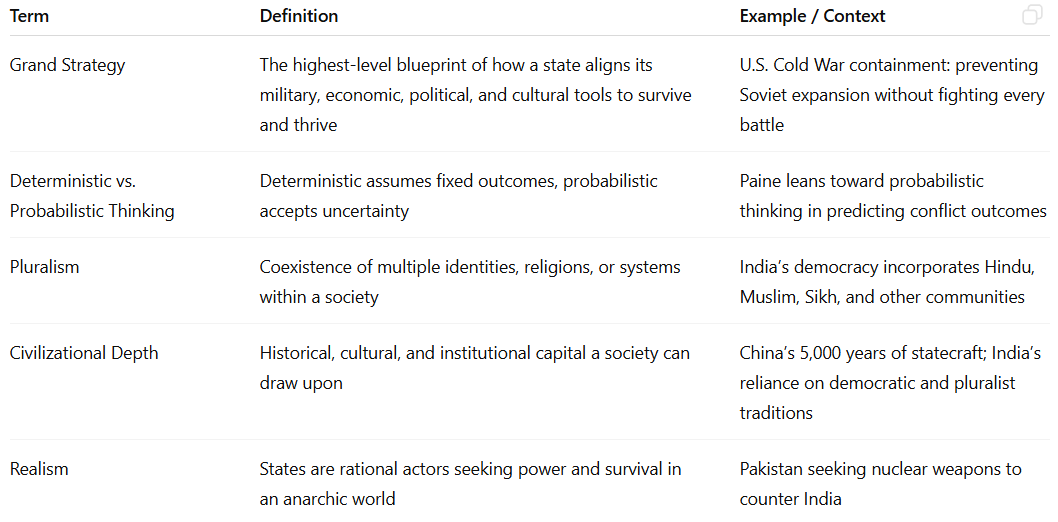
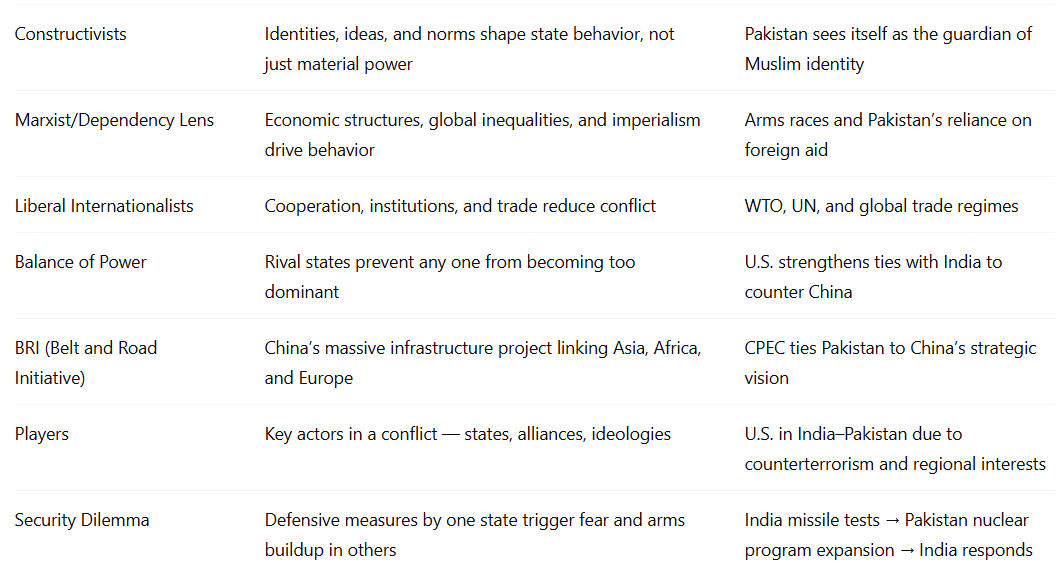
Key Terms: Foundations for Understanding
Understanding these terms will help frame the India–Pakistan conflict in the context of grand strategy.

Paine’s Framework and Its Value
Paine’s central insight: wars are fought not only on the battlefield but in the alignment of national resources, political goals, and civilizational identity. A nation that wins a battle but overstretches itself, like Napoleon or Hitler, ultimately loses the grand strategic game.
She contrasts powers that invest in trade, alliances, and economic networks (which sustain longevity) with those that chase short-term territorial gains (which exhaust resources).
Applying this lens, we can examine how India and Pakistan prioritize resources differently and why that shapes their long-term survivability.
Applied to South Asia:
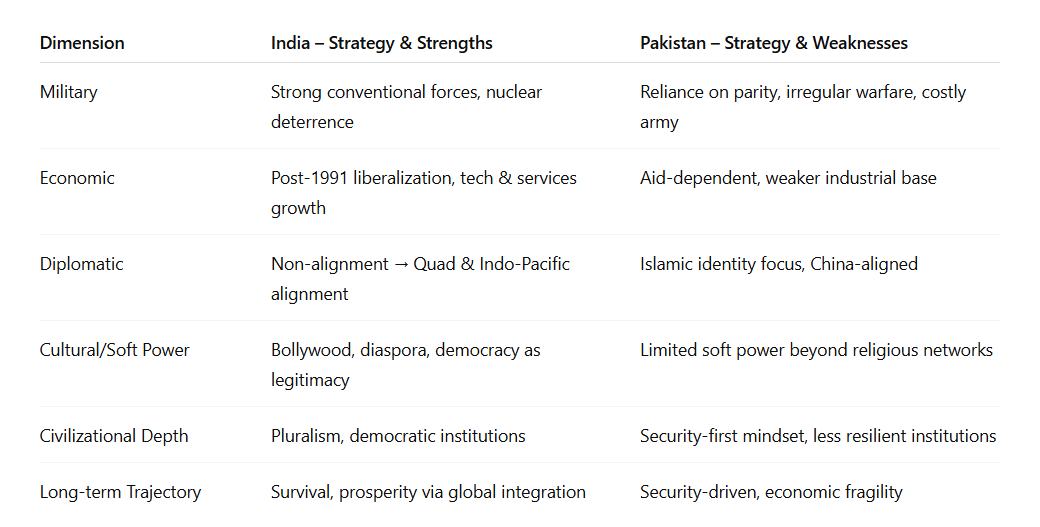
- Pakistan often focuses narrowly on military struggle with India, investing heavily in the army and nuclear deterrent, sometimes at the expense of economic growth.
- India, while military-minded, sometimes leans toward a more pluralistic, civilizational strategy: seeking legitimacy through democracy, global partnerships, and soft power (Bollywood, IT, diaspora).
- From Paine’s lens, India’s approach aligns better with long-term survivability, though it faces internal contradictions.
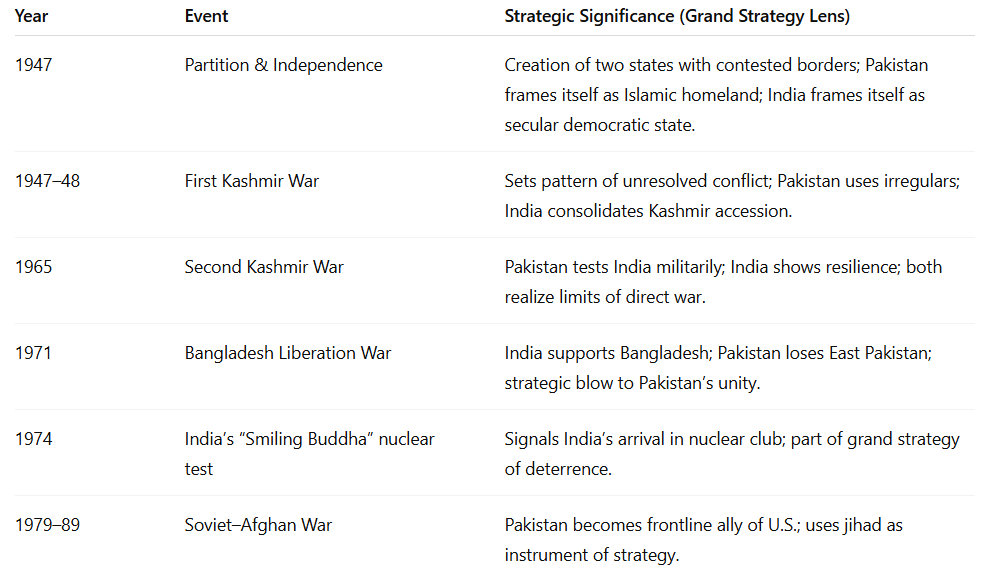
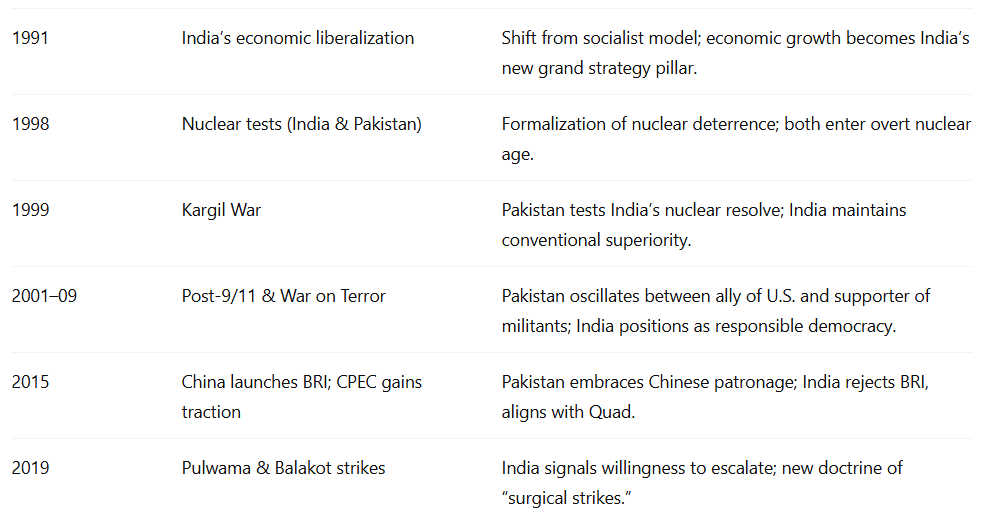
Timeline of the India–Pakistan Conflict and Strategic Implications
To better understand the long-term dynamics of the India–Pakistan conflict, it is helpful to review a concise timeline of major strategic events. This timeline highlights key moments where military, economic, and diplomatic actions shaped the trajectory of both nations. It provides the historical backbone for analyzing how each state’s grand strategy evolved.
The following timeline highlights major events that shaped India and Pakistan’s strategies, setting the stage for long-term competition.
Timeline of the India–Pakistan Conflict and Strategic Implications

Having reviewed the historical trajectory in the timeline above, it is helpful to summarize the relative strengths and weaknesses of India and Pakistan. This snapshot provides a clear context for understanding how each state allocates resources, prioritizes objectives, and aligns short-term actions with long-term civilizational ambitions
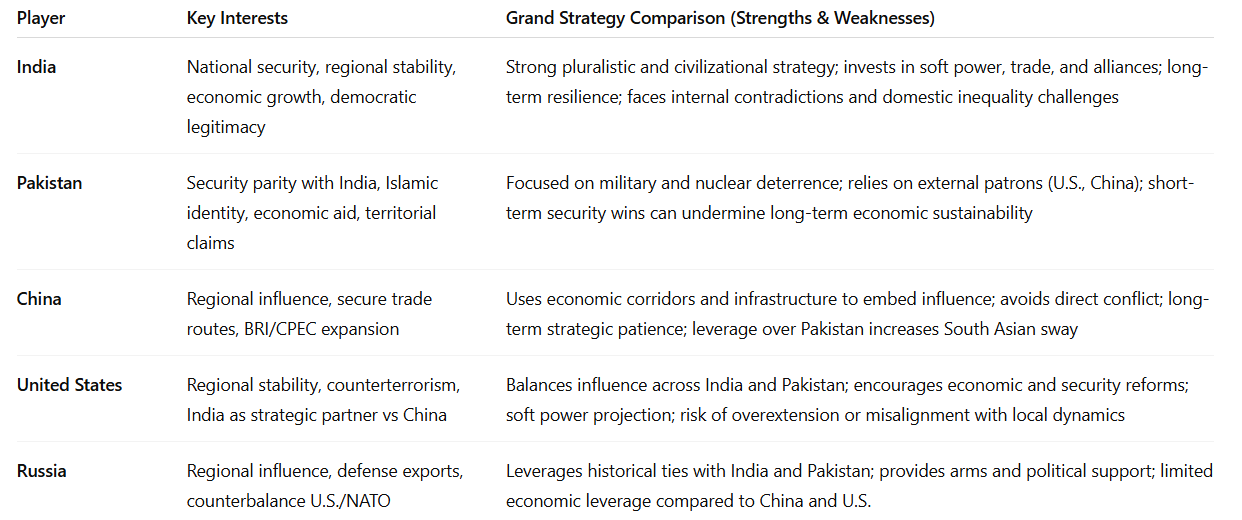
Players & Their Interests, and Grand Strategy Comparison
Before analyzing the strategies themselves, it is essential to understand who the key actors are and what drives them. In the India–Pakistan context, multiple players, both domestic and international, shape the decisions and trajectories of these two nations. India and Pakistan each pursue a mix of security, economic, and civilizational goals, while external powers such as the U.S., China, Russia, and Japan influence the strategic environment through alliances, trade, and geopolitical positioning.
Once we clarify the interests of each player, we can more meaningfully compare their grand strategies: how they allocate resources, prioritize objectives, and balance short-term tactical concerns against long-term civilizational ambitions. This approach provides a structured lens to evaluate not just battles or crises, but the enduring patterns that determine survival and influence over decades.
Players, Interests, and Grand Strategy Comparison

Critiques & Alternate Views
S.C.M. Paine’s framework is powerful, but not the only lens.
- Realist Critics (John Mearsheimer): Overemphasize civilizational depth; argue that power and military capability ultimately determine outcomes
- Constructivist Critics (Alexander Wendt, Nicholas Onuf): Focus on ideas, norms, and identity; mutual perceptions shape legitimacy and behavior
- Marxist / Dependency Critics: Highlight global economic pressures and aid dependence; Pakistan’s reliance on U.S./China framed as economic survival
- Alternative Grand Strategists:
- Edward Luttwak: Strategy as paradox; India–Pakistan may escalate predictably but counterintuitively
- Paul Kennedy: Rise/fall of powers via economic exhaustion; Pakistan risks overextension
- Henry Kissinger: Balance-of-power diplomacy; U.S. should keep both nations engaged, tilted toward India
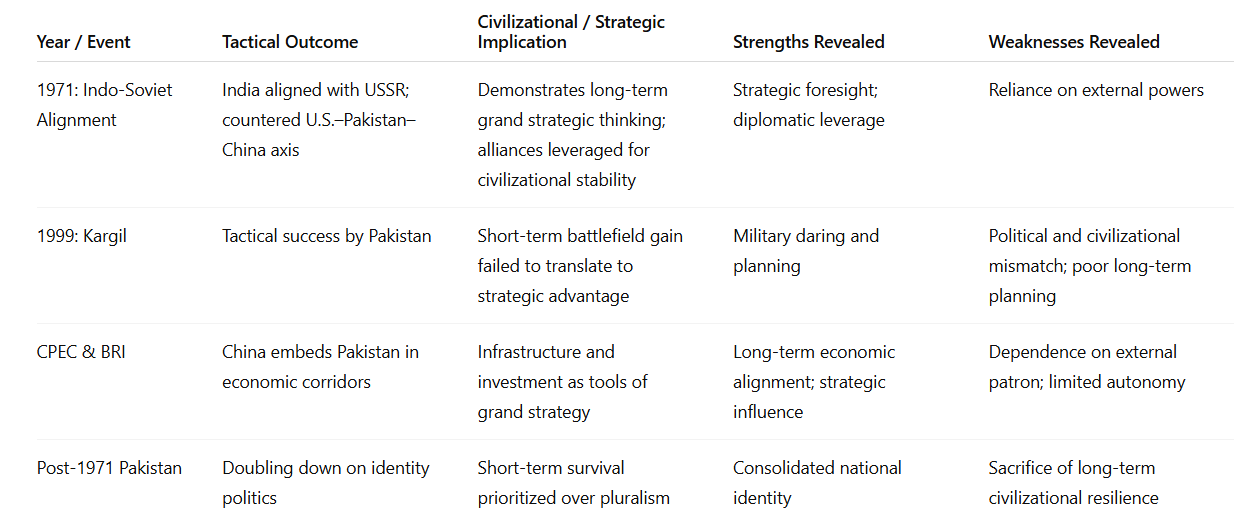
Integrating Historical Events with Grand Strategy Lessons
To understand how India and Pakistan’s actions fit into S.C.M. Paine’s concept of grand strategy, it helps to look at key historical episodes not just as isolated events, but as decisions reflecting broader national priorities. The table below ties major events to their tactical outcomes, civilizational implications, and the long-term strengths and weaknesses they reveal. This approach makes it easier to see patterns in strategy, beyond short-term battles or crises.

Closing Reflections
Grand strategy is not about predicting who “wins” the next skirmish but illuminating pathways to endurance. Paine reminds us that states are civilizations navigating time.
For India and Pakistan:
- Can India rise globally while tied down by perpetual rivalry?
- Can Pakistan survive by defining itself against India alone?
- Can outside powers (U.S., China, Russia, Japan) tilt the balance toward peace or entrenchment?
Grand strategy doesn’t provide easy answers, but it clarifies how today’s choices accumulate into the civilizational trajectories of tomorrow.
South Asia, seen through this lens, is more than a regional rivalry; it is a test case for 21st-century civilization-level strategy.
P.S. I’m neither a historian nor a geopolitical analyst. Listening to S.C.M. Paine’s podcasts and exploring prompted me to think about the broader dynamics of grand strategy. This post is my attempt to share that perspective; a lens, not a definitive analysis.
All errors are my own. If anything in this post resonates or seems clear, it’s thanks to S.C.M. Paine’s ability to articulate her ideas so effectively.