The Promise of Infinity
Stand on a hill above a modern city at night.
The view looks almost alive: streetlights snake like arteries, towers glow like mountains of glass, jets blink overhead like moving stars. Beneath those lights are millions of homes, businesses, hospitals, and schools. The electricity flowing through those cables is powering lives that would look like miracles to our ancestors.
Not so long ago, human beings lived in darkness, lit only by flame. Progress was slow, fragile, and often reversed by famine, plague, or war. For thousands of years, it seemed that civilizations rose only to fall. And many concluded: that is simply the way of the world. Progress comes in cycles. Collapse is inevitable.
But what if that story is wrong?
The physicist David Deutsch argues that progress is not a lucky accident, nor a brief flare before decline. It is something far deeper: the beginning of infinity. His claim is simple to state, but radical in implication: problems are inevitable, but problems are solvable. And because new problems will always arise, so too will new solutions. If we preserve the means to generate and correct knowledge, progress can continue endlessly.
Infinity here does not mean perfection. It does not mean that life will get easier without effort, or that catastrophe is impossible. It means something subtler but more powerful: there is no natural ceiling to improvement. Progress can be unbounded, if we protect the conditions that make it possible.
“Infinity” does not mean perfection, paradise, or destiny. It means no final limit to progress. Every problem we face, no matter how daunting, is in principle soluble with the right knowledge. Progress doesn’t end. It opens new horizons.
This post explores what it means to live at the beginning of infinity. We’ll look at civilization as an error-correcting knowledge engine, the moral and practical implications of infinite improvability, the strongest critiques of this vision, and finally what it means for each of us — personally, culturally, and as a civilization.
With this post, we conclude Section 3: The Engine of Progress. Having built the case for how knowledge grows and why progress compounds, we now turn to the horizon itself: the infinity of improvability.
Civilization as an Error-Correcting Knowledge Engine
What makes civilizations thrive is not wealth, land, or armies; it is the people themselves. It is the ability to generate and refine knowledge.
Knowledge, in Deutsch’s sense, is information that survives error correction. Most ideas in history have been wrong. But through trial, criticism, and improvement, some survive because they work reliably. Civilization progresses when it institutionalizes this process.
Think of navigation. For centuries, sailors tried to cross oceans by watching stars, guessing distances, and praying for luck. Many wrecked. Over time, errors were corrected: better maps, improved compasses, and more accurate ways to measure longitude. Each mistake became a lesson. Each correction improved the system. Eventually, humanity built GPS satellites — a global positioning system that constantly error-corrects in real time, recalculating and updating your position within a few meters.
Civilization is, at its heart, the same: a system that progresses by error correction.
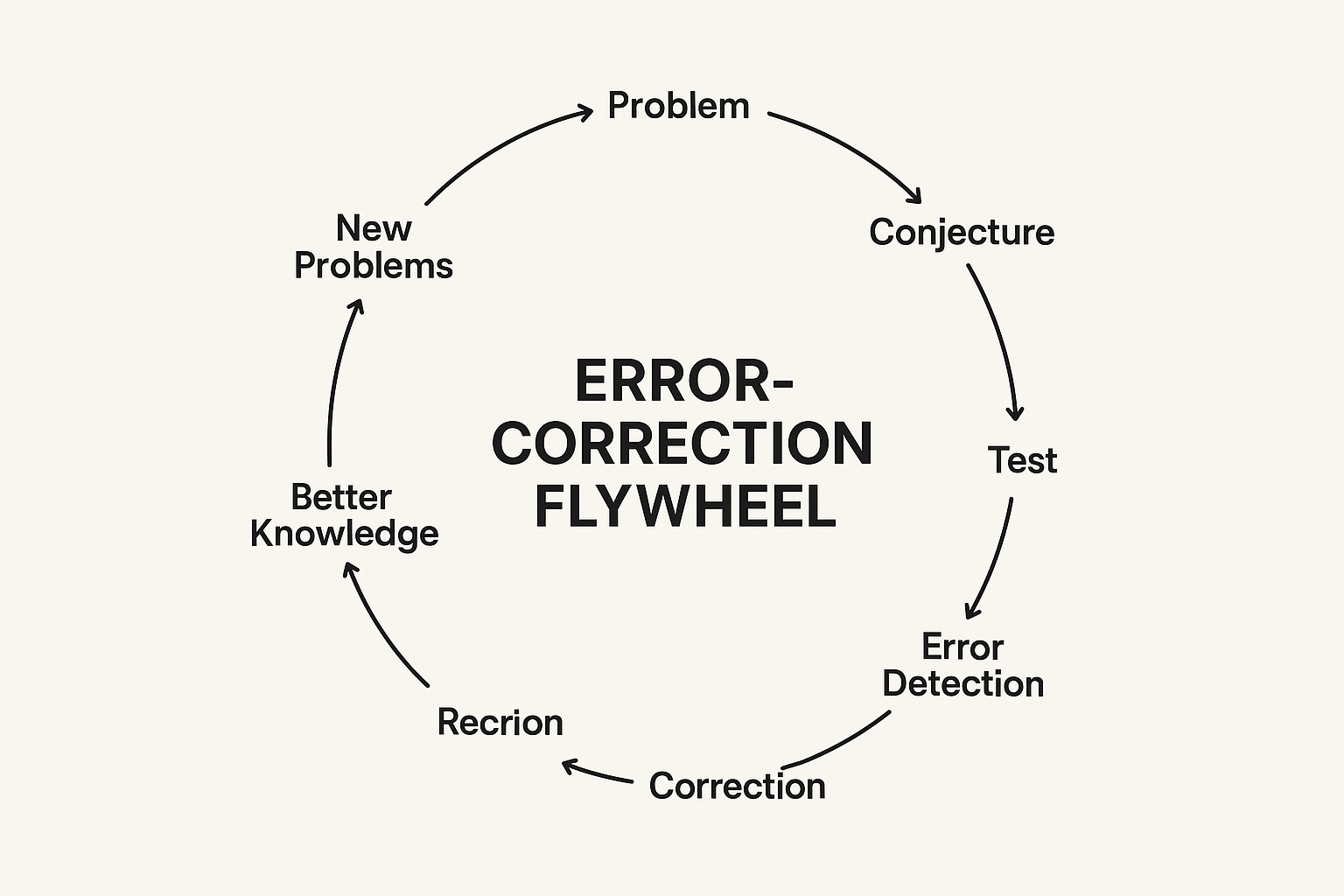
The Error-Correction Flywheel
Problem → Conjecture → Test → Error Detection → Correction → Better Knowledge → New Problems → (loop repeats)This flywheel of error correction has no built-in stopping point. So long as errors can be identified and corrected, progress can continue indefinitely.
Stories of the Knowledge Engine
- The Printing Press:
- The Scientific Revolution: For centuries, Aristotle’s physics and Galen’s medicine were treated as untouchable truths. The revolution wasn’t just about discoveries; it was about a new method: conjecture, experiment, criticism, and correction. Knowledge could now grow systematically, beyond the reach of any single authority.
- Apollo 13: When an oxygen tank exploded 200,000 miles from Earth, NASA faced a situation with no precedent. Engineers improvised a CO₂ scrubber from duct tape, plastic bags, and manuals. Error correction in real time — test, adapt, re-test — brought the astronauts home. This was not just luck. It was civilization’s flywheel applied under pressure: knowledge + error correction = survival.
- Abolition of Slavery: Slavery was as old as civilization itself. For millennia, it was assumed to be permanent. But through debate, criticism, and reform, it was dismantled. This shows the deepest moral lesson: even the “natural order” can be overturned by error correction
Failure Modes: When the Engine Stalls
Not all civilizations have embraced error correction. Some actively shut it down.
Ancient Egypt lasted millennia but changed little, because pharaohs controlled knowledge and suppressed dissent. Medieval Europe burned heretics instead of listening to them. The Soviet Union censored biology (Lysenkoism), and millions starved.
Civilizations don’t collapse because progress is impossible. They collapse because they silence criticism, block correction, and let errors accumulate until the system breaks.
The Moral and Practical Implications of Infinite Improvability
If progress can, in principle, be infinite, then what does that mean for us?
The Moral Dimension
If problems are soluble, then preventable suffering is not destiny; it is a failure of responsibility.
Poverty is not eternal. Disease is not eternal. Injustice is not eternal. These are solvable problems waiting for knowledge.
This means we carry a duty: to preserve and improve the institutions of error correction. To give future generations not just our knowledge, but the means to create better knowledge.
And it reframes failure. Failure is not shameful. Failure is feedback. The only real failure is refusing to learn.
The Practical Dimension
Infinite improvability doesn’t mean automatic improvement. Civilizations can stagnate or collapse. But it does mean there is no final wall, no point at which progress must end.
It also reframes risk. Nuclear weapons, pandemics, and climate change, are all products of progress. But all are also solvable by better progress. The same engine that creates dangers also creates the means to overcome them.
Democracy isn’t just majority rule. It’s a knowledge system. Free speech, a free press, checks and balances, independent courts — these are mechanisms for detecting and correcting errors before they destroy society. Democracy is civilization’s bug-tracking software.
COVID-19 showed improvability in action:
- New problem: novel virus.
- Knowledge response: mRNA vaccines in under a year.
- New problems: variants.
- New knowledge: updated vaccines.
This process never ends. But it also never has to.
Anticipating Critiques
“No vision of infinite progress should be taken on faith. Critics raise real challenges. Here are the strongest, and why Deutsch believes they don’t stop the journey.”
Hubris
Isn’t believing in infinite progress arrogant?
Response: Optimism isn’t prophecy. It doesn’t say progress is inevitable. It says progress is possible. Problems can be solved, but only if we choose to solve them. Optimism is responsibility, not arrogance.
Planetary Limits
How can progress be infinite on a finite planet?
Response: Knowledge transforms what counts as a limit. Humans once worried about running out of wood for fire. Then coal, then oil, then nuclear, now solar. The Stone Age didn’t end because we ran out of stones.
Historical Collapses
But haven’t all civilizations collapsed?
Response: Yes, but collapse is not destiny. Civilizations fall when they abandon error correction — when dogma or authoritarianism silences criticism. Collapse is not a law of nature. It is a choice.
The Dark Side of Progress
Progress gave us nuclear weapons, pollution, and inequality.
Response: Every new knowledge creates new problems. But improvability means those problems are solvable, too. The alternative is stagnation, and stagnation guarantees collapse.
Wall vs. Horizon: Two Futures in Our Minds
Every debate about progress eventually comes down to a picture in our heads. Some see a wall. Others see a horizon.
The Wall Mindset believes that civilization is on borrowed time. Growth cannot go on forever, resources are finite, human ingenuity will eventually run dry, and all we can do is brace for impact. History is filled with such predictions: Thomas Malthus insisting that population would always outpace food, or early 20th-century physicists convinced that almost everything important had already been discovered. Even today, many arguments against optimism echo the same theme: we will hit the wall of energy, of morality, of intelligence, of stability.
The Horizon Mindset sees things differently. To look at the horizon is to see an ever-receding boundary. The closer we get, the farther it stretches. Problems are not dead-ends but doorways. The more we discover, the more there is to discover. Space was not the last frontier; it only opened new ones. Smallpox was eradicated, and in its place we now confront new diseases, new cures, new biological puzzles. The same pattern repeats in physics, technology, and even morality: each solved problem expands the horizon.
This is the true meaning of infinite improvability. We are not racing toward a final ceiling where progress will stall. We are walking toward a horizon that always moves with us. The choice is not between utopia and collapse, but between a world that mistakes horizons for walls, and one that understands that the horizon never ends.
- Wall Mindset: Limits are permanent. Once you hit them, progress stops
- Horizon Mindset: Limits are temporary. As you walk, the horizon recedes. Knowledge shifts what “limits” mean
What This Means for You
The beginning of infinity is not just a civilizational idea. It is also a personal stance.
Personal Level
- Treat your own life as improvable
- See mistakes as corrections-in-waiting
- Don’t fear being wrong. Fear refuses to be corrected
Cultural Level
- Defend institutions that allow criticism: free science, free press, open debate
- Resist narratives that glorify dogma or inevitability
Civilizational Level
- Recognize that progress is a choice, not a law
- Every generation inherits not just knowledge, but the responsibility to keep error correction alive
Everyday Error Correction
Error correction isn’t just for science or politics. You already use it daily:
- Debug code until it runs
- Training for a marathon, adjusting after each run
- Learning a new language, correcting mistakes as you go
The same principle that guides civilization guides personal growth.
Where Do We Go Next
We’ve seen that knowledge grows by error correction. That civilization itself is an error-correcting engine. That progress is not a brief spark but can, in principle, continue without end. We stand at the beginning of infinity.
But philosophy is not enough. If progress can be infinite, the urgent question becomes: how do we design systems, institutions, and cultures that keep improvability alive?
That takes us to Section 4: The Operating System – Applying Deutsch’s Blueprint.
There, we’ll ask:
- How do we deliberately build institutions that resist dogma?
- How do we design cultures that encourage criticism?
- How do we live as individuals inside the infinite game?
Where We Stand
The Beginning of Infinity is not a promise. It is not a guarantee. It is an invitation. “The lights of our cities are not the end of the story. They are the first flickers of infinity.”