Introduction
Have you ever noticed how the same historical figure can be portrayed as a saint, a villain, or a pragmatic leader, depending on who’s telling the story? The history you read in school, see in films, or scroll past online may tell a very different story from the same events described a century ago. That’s because history is never neutral; it’s filtered through bias: the lens of the historian, the storyteller, and the culture they inhabit.
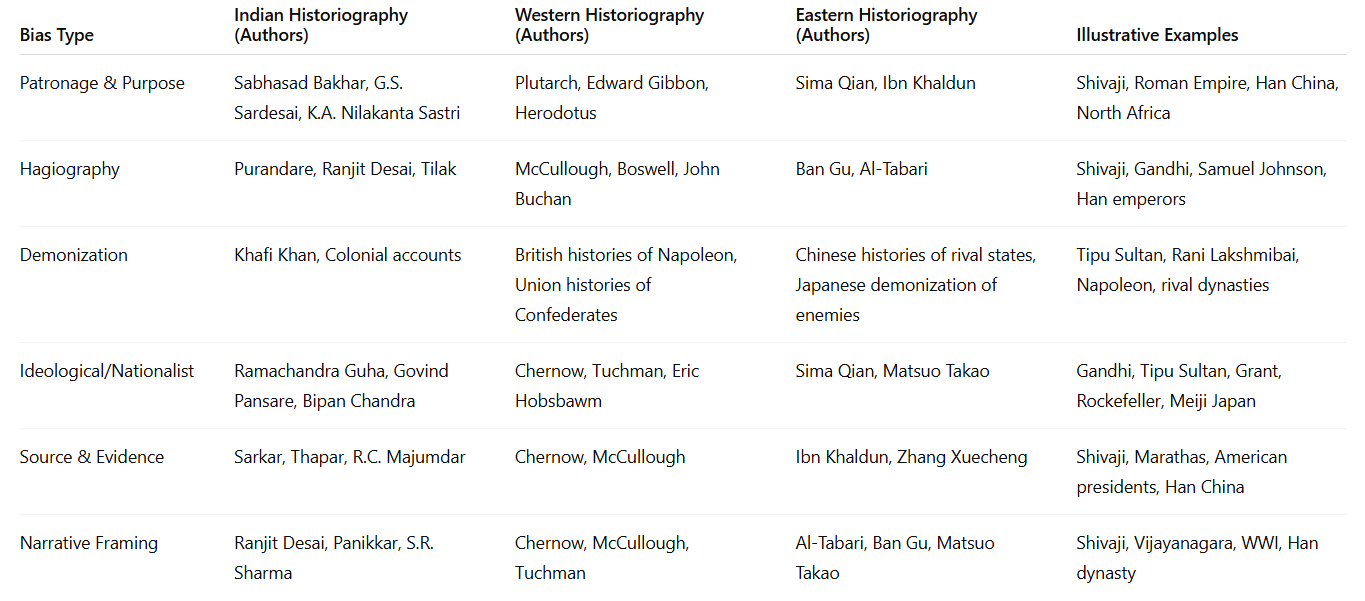
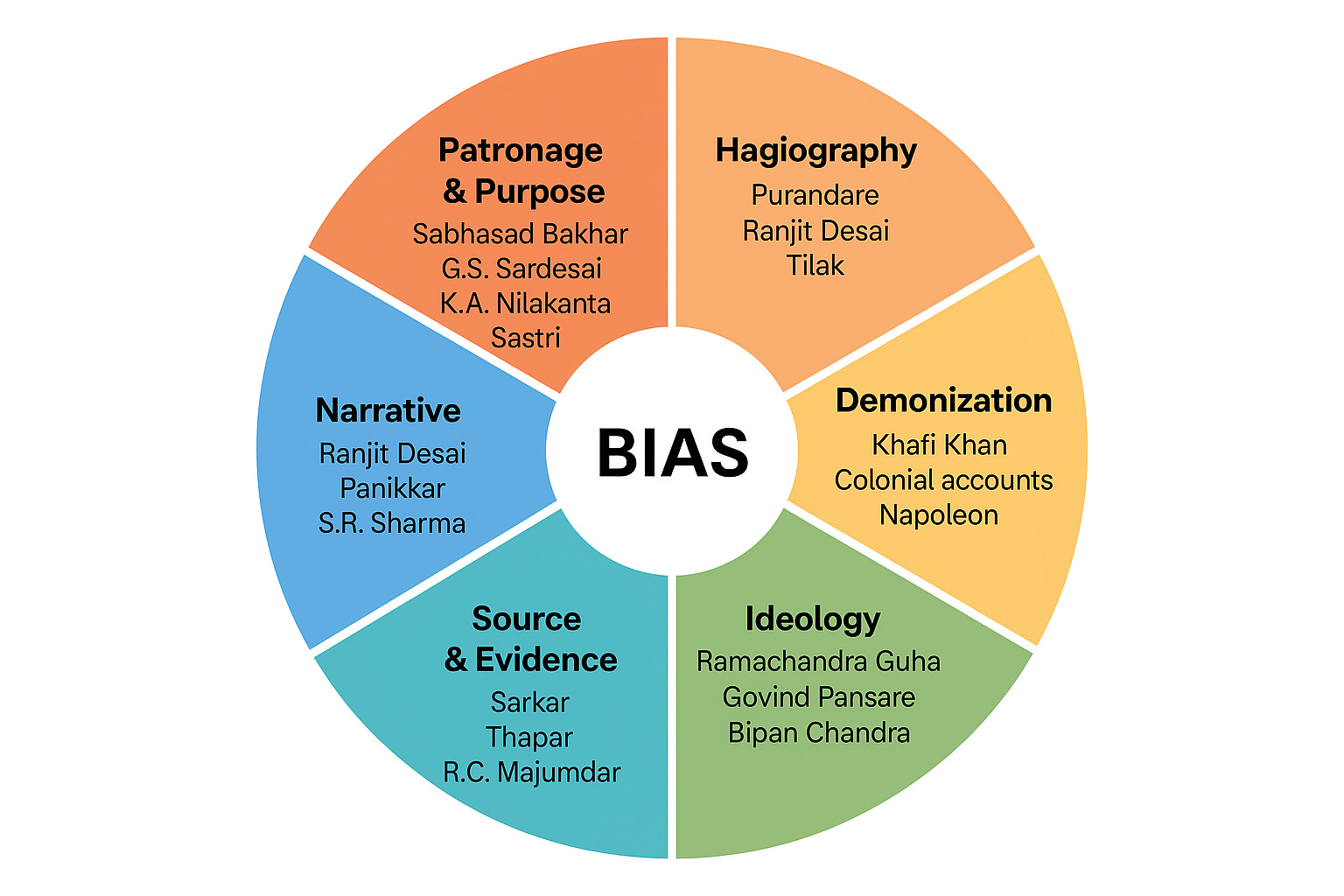
Patronage and Purpose Bias
Definition: History is often written to please wealthy patrons, legitimize political power, or promote particular ideologies. The author’s purpose shapes what is emphasized and omitted.
- Indian examples:
- Sabhasad Bakhar (Shivaji)
- G.S. Sardesai (Maratha history)
- K. A. Nilakanta Sastri (South Indian dynasties)
- Western examples:
- Edward Gibbon (Roman Empire)
- Plutarch (moral biographies)
- Herodotus (Persian Wars, Greek lens)
- Eastern examples:
- Sima Qian (Records of the Grand Historian, China)
- Ibn Khaldun (North Africa/Middle East, 14th century)
Hagiography and Demonization
Definition: Hagiography idealizes historical figures—portraying them as saints, heroes, or flawless leaders. Demonization does the opposite, vilifying individuals as villains, traitors, or enemies, often exaggerating their flaws.
- Hagiography (idealization):
- India: Babasaheb Purandare, Ranjit Desai, Tilak
- West: McCullough (Washington, Lincoln), Boswell (Samuel Johnson), John Buchan (British leaders)
- East: Ban Gu (Chinese historian, Han dynasty), Al-Tabari (Islamic scholar portraying caliphs favorably)
- Demonization (vilification):
- India: Khafi Khan (Shivaji), colonial accounts on Tipu Sultan and Rani Lakshmibai
- West: Napoleon in British histories, Confederate generals in Union narratives
- East: Chinese historiography often demonized rival states; Japanese historians sometimes glorified samurai while demonizing enemies
Anecdote: In some Indian textbooks, Tipu Sultan is alternately called a freedom fighter or a religious oppressor, a perfect illustration of bias shaping public memory.
Ideological and Nationalist Framing
Definition: Historians may interpret events and figures through the lens of their personal or national ideology (e.g., liberal, Marxist, nationalist), framing narratives to support those worldviews.
- India: Ramachandra Guha (liberal/secular lens), Govind Pansare (Marxist), Bipan Chandra (Indian freedom movement)
- West: Ron Chernow (Grant, Rockefeller), Barbara Tuchman (narrative history), Eric Hobsbawm (Marxist interpretation of modern history)
- East: Sima Qian’s works subtly reinforced Han political ideology; Japanese historian Matsuo Takao framed Meiji modernization positively
Source and Evidence Bias
Definition: The choice, availability, and reliability of sources affect historical accounts. Reliance on particular types of evidence—literary, archaeological, official records—can skew or limit the story presented.
- India: Jadunath Sarkar (triangulating Persian, Marathi, European sources), Romila Thapar (archaeological, literary, epigraphical), R.C. Majumdar (ancient and medieval India)
- West: Chernow, McCullough, David McCullough (archival, letters)
- East: Ibn Khaldun (sources from various Maghreb and Arab regions), Zhang Xuecheng (Chinese historiography emphasizing moral lessons in statecraft)
Narrative Framing Bias
Definition: How events are structured, sequenced, and contextualized creates a narrative that highlights some details while downplaying others, shaping readers’ understanding.
- India: Ranjit Desai, K. M. Panikkar, S. R. Sharma (medieval Indian political narratives)
- West: Chernow, McCullough, Barbara Tuchman, David McCullough
- East: Al-Tabari, Ban Gu, Japanese historians like Matsuo Takao
Patterns Across Cultures
Ask yourself
- Whose lens am I seeing this story through?
- Which traits or events are emphasized, and which are minimized or omitted?
- How might another historian from a different time or culture tell this story?
Recognizing bias turns history from a static record into a dynamic conversation across time.
Conclusion
History isn’t just what happened; it’s how we choose to see it. Saints and sinners, rebels and rulers, conquerors and visionaries all coexist in the tapestry of human memory. Understanding bias enriches history, giving us the full spectrum of human complexity.