The outsourcing industry is running into a storm. Higher H-1B visa fees, the proposed HIRE Act, shrinking profit margins, and the slow erosion of labor cost advantages are converging at once. Even Global Capability Centers (GCCs), once the dependable cushion, are being questioned. The playbook that carried Indian IT firms through decades of growth is being rewritten quickly.
The numbers underline the shift. H-1B fees have jumped from $4,500 to $100,000 per employee. For TCS, which expects 5,500 approvals in 2025, that’s an extra $550 million, nearly 10% of its projected profit. Infosys and Wipro face the same squeeze.
The HIRE Act adds another layer of pressure: a 25% excise tax on U.S. revenue. For a firm with $10 billion in U.S. business, that means $2.5 billion in taxes. BFSI and retail contracts would be hit hardest. At the same time, the labor cost advantage that powered offshore growth is narrowing. Indian staff, once 30–40% cheaper than U.S. counterparts, no longer offer the same decisive edge. Firms are being forced to rethink local hiring, automation, and nearshoring.
Margins are already thin. Choices that once felt routine, such as expanding a delivery center, relocating staff, and securing a new U.S. client, now carry significant financial consequences.
Mid-tier firms are under particular strain. Many rely almost entirely on offshore staff. Some are passing costs directly to clients, others are cutting headcount, delaying new services, or freezing expansion. The message is clear: scale down U.S. dependency or risk getting squeezed out.
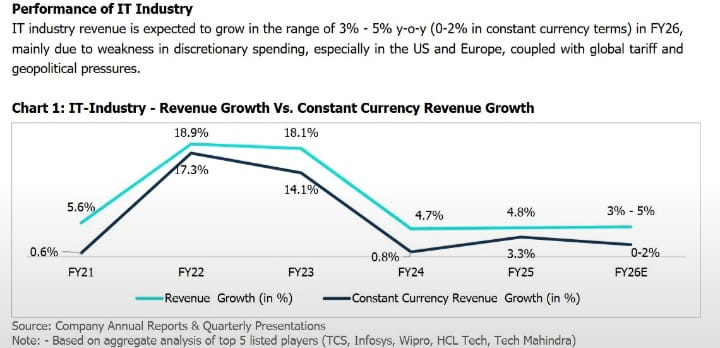
Industry growth numbers reflect the slowdown. Analysts project only 3–5% revenue growth for FY26, with constant currency growth stuck at 0–2%. Tariff headwinds, weak discretionary spending, and sluggish demand in the U.S. and Europe leave little room for error. Against that backdrop, extra costs from H-1B hikes and a new excise tax feel like heavy ballast.
India has built a formidable GCC network: over 1,800 centers producing $76 billion in direct output and another $62 billion in exports. These centers once absorbed U.S. workloads and kept costs manageable. Now they face new scrutiny.
The HIRE Act could tax intercompany transactions, undercutting the cost advantage of captives. Anti-abuse clauses could drive costs up further. Some companies are already considering relocating centers to tax-neutral hubs such as Poland or Mexico, or converting them into standalone entities. Future expansion is likely to focus on high-value work and automation rather than raw headcount.
Even with scale, GCCs can no longer be counted on as guaranteed relief. A 3,000-person center may absorb 15–20% more U.S. work, but tax rules, relocation costs, or new regulations could wipe out that buffer quickly.
For IT firms, every lever is under review. H-1B fees could add hundreds of millions in annual costs. GCCs provide some breathing room through automation, staff upskilling, or shifting work, but the benefit depends on how new tax rules are written and enforced.
Labor arbitrage, once the foundation of the model, is fading. Local hiring is becoming a necessity. Nearshoring offers partial relief but comes with higher wage bills. Delays in automation or half-hearted execution could mean layoffs, slower project delivery, and lost contracts.
If U.S. revenue dips sharply, offshore operations will not be able to fully compensate. That would shrink global footprints and contract sizes. Relocation of GCCs may create further disruption, eating into India’s long-held cost advantage. Agility: moving quickly, cutting losses, rebalancing delivery; will decide who adapts and who stumbles.
The impact on workers is immediate. Visa sponsorship is harder to secure. Hiring freezes and layoffs loom large. Predictable career paths now look fragile.
Opportunities in the U.S. are narrowing, pushing talent to explore other geographies like Canada, Germany, or Australia. Reskilling and building expertise in high-value areas are no longer optional. Geographic flexibility is becoming a baseline requirement.
Automation is the obvious first move: AI tools, bots, and streamlined processes that reduce dependence on expensive labor. Local hiring and nearshoring help avoid visa complications and client concerns. Diversifying into consulting, cloud, and other high-value services helps preserve margins. Some firms will pass costs to clients. Others will expand in Europe, APAC, or the Middle East to soften U.S. dependency.
Contingency planning for GCCs is no longer a niche exercise. Relocation, restructuring, or shrinking India-based capacity are all scenarios companies must prepare for. Those who anticipate these shifts will be better placed to manage disruption.
U.S. policy changes are reshaping the outsourcing model. Margins are under pressure, revenue growth is slowing, and labor cost arbitrage no longer offers cover. GCCs, once the safety net, are now part of the problem as much as the solution.
For companies, strategic diversification and contingency planning are unavoidable. For employees: reskilling, geographic flexibility, and specialization are the new currency.
The industry isn’t facing tactical challenges; it’s facing structural ones. The firms that pivot early will survive. Those who cling to the old playbook will not.
References
- USCIS: H-1B Fee Schedule, 2025
- Proposed HIRE Act legislation details: U.S. Congress, 2025
- Nasscom IT Industry Report FY26: Revenue Growth Forecasts
- Company filings: TCS, Infosys, Wipro: H-1B approvals & cost estimates
- Everest Group: GCC operations and offshoring analysis, 2025