Every technological revolution changes the economics of scarcity. Every change in scarcity eventually changes the way we organize ourselves.
Over the past few years, several wealth managers and investment advisors have approached me with a familiar proposition. They would understand my financial goals, assess my risk profile, recommend a portfolio built around mutual funds or model allocations, periodically rebalance it, and manage my investments on my behalf.
I gradually realized we were solving different problems.
Their approach was designed to serve thousands of investors efficiently. Mine is designed to evolve. Every book I read, every business I study, every technological shift I understand, and every new mental model I acquire changes my thinking about capital allocation. My investment philosophy is not fixed. It evolves continuously, and my portfolio evolves with it.
A portfolio is far more than a collection of securities.
It is a visible expression of how someone understands the world.
Standardized portfolios solve a different problem.
For decades, that trade-off seemed unavoidable. Deep personalization was expensive. Delivering bespoke investment advice required analysts, research departments, expensive financial data, portfolio specialists, compliance teams, and years of accumulated expertise. Institutions existed because expertise itself was expensive to assemble and coordinate.
That realization led me to a much broader question.
Why are institutions so large in the first place?
Most explanations point toward capital, regulation, distribution, or brand. Those are certainly part of the story.
I believe there is a deeper explanation.
Institutions exist because they concentrate scarce resources. Sometimes that resource is machinery. Sometimes it is capital. Sometimes it is expertise.
Every major organizational form emerged because it solved an economic constraint.
Factories concentrated expensive machinery.
Banks concentrated capital.
Universities concentrated scholars.
Hospitals concentrated specialists.
Investment firms concentrated research.
Consulting firms concentrated expertise.
The concentration made economic sense because the underlying resource was scarce and expensive to coordinate. If expertise was difficult to produce, organizations naturally formed around collecting it in one place.
Every technological revolution changes the economics of scarcity.
The Industrial Revolution dramatically reduced the cost of physical labor by the use of machines. The Information Age dramatically reduced the cost of communication through networks.
Cognitive leverage is beginning to reduce the cost of cognitive work.
Research, synthesis, coding, writing, planning, analysis, translation, documentation, and many other forms of knowledge work require dramatically less effort than they did only a few years ago. Expertise itself does not become less valuable. If anything, judgment becomes even more valuable.
What changes is the economics of producing and applying expertise.
The consequence is not that expertise disappears. The consequence is that expertise no longer needs to be concentrated to produce institutional-quality outcomes.
That simple shift has profound implications.
It changes the economics of the institution itself.
Many technologists have arrived at similar conclusions from different directions. Sam Altman has spoken about one-person billion-dollar companies. Naval Ravikant has argued that software and AI dramatically increase individual leverage. Balaji Srinivasan has written extensively about technology increasing individual agency while reducing dependence on traditional organizations.
Their observations appear different on the surface. I believe they are describing the same underlying transition.
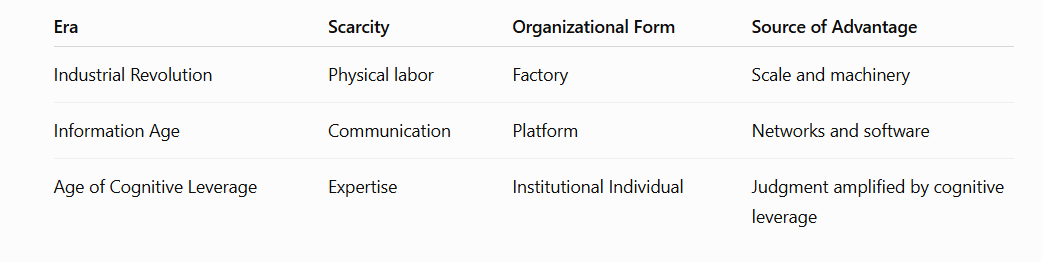
The table suggests a broader pattern.
Every technological revolution changes what is scarce.
Every change in scarcity eventually changes the way we organize ourselves.
Perhaps the most important organizational change of cognitive leverage will not be better models or larger companies.
It will be the emergence of a new economic actor.
The Institutional Individual.
Definition
An Institutional Individual combines deep domain expertise, judgment, cognitive leverage, and intelligently designed systems to deliver capabilities that historically required an institution.
The Institutional Individual is defined not by working alone but by possessing institutional capability.
They treat knowledge as something to compound rather than something to possess. They build systems instead of hierarchies. They automate routine cognitive work while retaining responsibility for judgment. They remain directly accountable for outcomes because judgment cannot be delegated. Above all, they continuously refine their understanding of the world, building better explanations to enable better decisions over time.
The distinction between institutions and Institutional Individuals is therefore much deeper than organizational size.
Institutions optimize for consistency. They coordinate large numbers of people through governance, repeatable processes, and standardization.
Institutional Individuals optimize for learning.
They can redesign their workflows overnight, integrate new knowledge immediately, and improve continuously because they coordinate only themselves and the systems they have built.
Institutions became powerful because they concentrated expertise. Institutional Individuals become powerful because they compound judgment.
Every institution is ultimately an answer to an economic constraint. When the constraint changes, the institution evolves with it.
The economics of institutions have always been shaped by scarcity. Cognitive leverage changes the economics of scarcity.
Investing as an Early Example
Investing offers one of the clearest illustrations of this transition because it has always been a business built around concentrated expertise.
For decades, the wealth management industry operated under a simple economic assumption: personalization was expensive. Every investor brought a different combination of goals, tax considerations, cash flow requirements, family circumstances, risk tolerance, time horizon, and beliefs about the future. Delivering truly personalized advice required research departments, portfolio managers, analysts, economists, compliance teams, and expensive financial data. Mutual funds, model portfolios, and standardized investment products emerged because they allowed relatively small teams to serve millions of investors efficiently.
The economics of deeply personalized investing have changed.
For decades, personalization was a luxury because every additional client required additional human expertise. Cognitive leverage changes that equation. As the costs of research, synthesis, monitoring, and analysis fall, deeply personalized investing becomes economically viable at a scale previously impossible. The question is no longer whether personalization is possible; it is whether standardized products remain the only practical way to deliver it.
Yesterday
Institutional Capability = Concentrated Expertise
Today
Institutional Capability = Judgment × Cognitive Leverage
That single change has implications far beyond investing. It changes who can deliver sophisticated investment advice, how portfolios are constructed, and ultimately what investors should be paying for.
A portfolio is never just a collection of securities. It is an expression of how someone understands the world.
Two investors with identical risk tolerance and financial goals may still build completely different portfolios because they hold different explanations about technology, demographics, energy, geopolitics, regulation, or the future of specific industries.
Investing is ultimately an exercise in judgment.
Judgment improves through learning.
Every new book, every business studied, every technological shift understood, and every mental model acquired changes the way an investor allocates capital. A portfolio should evolve because the investor’s understanding evolves.
Standardized portfolios solve a different problem. They optimize for efficient distribution across millions of clients. They were never designed to reflect continuously evolving individual worldviews.
An Institutional Individual is not replacing analysts with AI. They are replacing institutional processes with intelligently designed systems that amplify human judgment rather than substitute for it.
A research system can continuously monitor businesses, compare financial statements across years, summarize earnings calls, track management commentary, identify changes in valuation, monitor sector developments, surface contradictory evidence, highlight changes in competitive positioning, evaluate portfolio concentration, and assist with tax optimization.
The investor spends less time gathering information and more time exercising judgment.
The investor’s advantage no longer comes from collecting more information. It comes from building a better system for turning information into judgment.
The Institutional Individual does not operate in isolation.
They stand on an emerging Institutional Stack¹ consisting of foundation models, AI agents, Model Context Protocol (MCP), domain-specific data platforms, brokerage APIs, automation tools, proprietary workflows, and personal knowledge systems.
Just as cloud infrastructure enabled the SaaS revolution, this emerging Institutional Stack enables individuals to build capabilities that once required entire organizations.
The transition is already visible. The most interesting developments are no longer the AI models themselves. They are the investment infrastructure being built around them.
Tapetide, for example, exposes Indian market data via Model Context Protocol (MCP), allowing AI assistants to screen companies, compare financial statements, monitor institutional flows, analyze technical indicators, and construct sophisticated research workflows through natural language. Instead of forcing investors to navigate dozens of dashboards, the infrastructure itself becomes accessible to intelligent systems.
Around this ecosystem, developers have already built MCP integrations for brokerages such as Interactive Brokers, while established financial platforms are beginning to explore AI-native workflows of their own.
These developments may appear technical.
They are actually economic.
Investment infrastructure is evolving from software designed for humans to infrastructure designed for humans and intelligent systems working together.
Every technological transition begins with infrastructure.
Electricity enabled factories.
Cloud computing enabled SaaS.
APIs enabled the platform economy.
The Institutional Stack may enable the Institutional Individual.
The implications extend beyond investing.
The future advantage may no longer belong to investors with the largest research departments.
It may belong to those who build the best research systems.
For decades, the economics of wealth management were shaped by product distribution. Personalization was expensive, and standardized portfolios were the only practical way to serve millions of investors. As cognitive leverage reduces the cost of personalization, that model may begin to evolve. If every investor can have a portfolio tailored to their own goals, constraints, and worldview, value shifts away from distributing standardized products and toward building better decision systems. The long-term opportunity may lie in advisors being rewarded for the quality of judgment they bring and the quality of decision systems they help clients build, rather than primarily for the products they recommend.
That does not mean institutions disappear.
Far from it.
Large asset managers will continue to play an essential role. Index funds will remain an excellent solution for millions of investors. Mutual funds will continue serving investors who value simplicity, diversification, and professional management.
The point is different.
Institutional Individuals create a new option that previously did not exist.
The economics of deeply personalized investing begin to change.
That pattern extends far beyond finance.
Traditional consulting firms concentrated analysts because gathering information, building presentations, evaluating industries, and producing strategic recommendations required large teams.
Law firms concentrated legal expertise because research and document preparation demanded enormous effort.
Universities concentrated scholars because knowledge was difficult to access and distribute.
Education standardized classrooms because one teacher could only personalize learning for a limited number of students.
As cognitive leverage reduces the cost of knowledge work across these professions, value shifts away from gathering information and toward exercising judgment.
The details differ.
The economics remain remarkably similar.
Perhaps that is the broader lesson.
The Institutional Individual is not simply a better investor. It is a new organizational form that becomes economically viable whenever technology changes the cost of expertise. Investing is simply one of the first places where that transition is becoming visible.
Beyond Investing
Investing is simply one example of a much broader transition.
Wherever institutions emerged to concentrate expertise, cognitive leverage changes the underlying economics.
Consulting firms grew by assembling teams of analysts capable of gathering information, synthesizing industries, building models, and producing recommendations. As research and synthesis become dramatically less expensive, the value increasingly shifts toward experience, judgment, and accountability rather than the number of consultants assigned to a project.
Education follows a similar pattern. Schools standardized learning because one teacher could realistically personalize education for only a limited number of students. As individualized explanations, adaptive learning, continuous feedback, and intelligent tutoring become economically viable, the teacher’s role shifts toward mentorship, intellectual taste, curiosity, and helping students develop sound judgment rather than simply delivering information.
The same logic applies to law, medicine, research, architecture, software engineering, design, accounting, and countless other knowledge professions.
The details differ.
The economics remain remarkably similar.
Whenever technology changes the cost of expertise, it changes the economics of the institution built around that expertise.
That does not mean institutions disappear.
Factories still exist.
Banks still exist.
Platforms continue to dominate large parts of the digital economy.
Likewise, investment firms, consulting firms, universities, hospitals, and law firms will continue to play indispensable roles. Institutions possess advantages that extend far beyond expertise. They provide trust, governance, regulation, brand, capital, distribution, risk management, and the ability to coordinate work at enormous scale.
The Institutional Individual is therefore not a replacement for institutions.
It is a new organizational form that becomes economically viable alongside them.
The relationship between institutions and individuals may begin to resemble the relationship between cloud infrastructure and startups. Large organizations continue to build the underlying platforms, while increasingly capable individuals create specialized, highly personalized, and rapidly evolving services on top of them.
That possibility is already visible in investing.
Traditional wealth management optimized for distributing products efficiently because personalization was expensive.
As cognitive leverage changes that equation, the value increasingly shifts toward designing better decision systems, continuously refining investment frameworks, and aligning portfolios with an investor’s evolving understanding of the world.
Perhaps the future of investing will not be defined by who manages the largest research department.
It may be defined by who builds the best research system.
The Next Question
Every technological revolution changes the economics of scarcity.
Every change in scarcity eventually changes the way we organize ourselves.
The Industrial Revolution reduced the cost of physical labor and gave us the factory.
The Information Age reduced the cost of communication and gave us the platform.
Cognitive leverage is dramatically reducing the cost of cognitive work.
If institutions were built to concentrate scarce expertise, what happens when expertise no longer needs to be concentrated?
Perhaps the defining organizational change of this era will not be larger companies, faster software, or even more capable models.
Perhaps it will be the emergence of a new economic actor capable of delivering institutional-quality outcomes without institutional scale.
The Institutional Individual is defined not by working alone but by possessing institutional capability through judgment, cognitive leverage, and intelligently designed systems.
Institutions became powerful because they concentrated scarce expertise. Institutional Individuals become powerful because they compound judgment.
If this framework is even partially correct, many of our assumptions about investing, consulting, education, software, law, medicine, research, and other knowledge professions deserve to be re-examined. These professions evolved in a world where expertise had to be concentrated. Cognitive leverage changes the economics of that concentration.
Every era changes what is scarce. Every change in scarcity creates a new way of organizing work.
Perhaps the Institutional Individual is the defining organizational form of the age of cognitive leverage.
¹ Institutional Stack: The technologies, data, protocols, and workflows that enable an individual to achieve institutional capability.